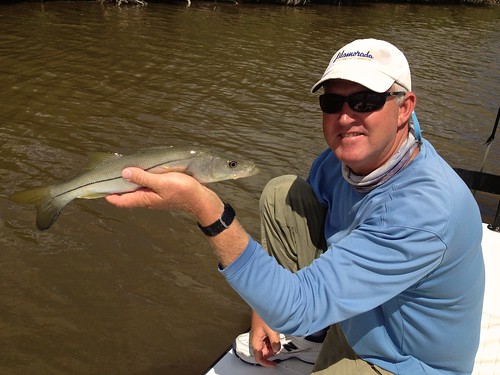
Showing posts with label nature girl. Show all posts

Friday, November 13, 2015

Palmetto Bay: A Peaceful Retreat from Mad Miami

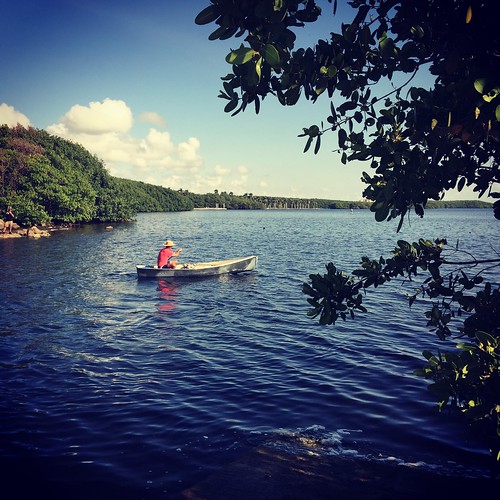
Canoeing Off Deering Point
My kinda morning commute. Deering Point in Palmetto Bay.


Because I love backyard traveling ...

Why are we more attached to all that's crazy hectic about routine life in Miami -- the traffic, the delays, the rudeness -- instead of being drawn to the magnificent nature that blankets some parts of the city? Is it because we prefer the familiar comforts of drama? Nature isn't crazy, hectic or rude -- it aint got time for that! Instead, it has all the time in the world to just be.

I recently had the chance to stay at a friend's house in Palmetto Bay, a city in southeast Miami-Dade skirted by Biscayne Bay and lush Old Cutler Road, shaded for dozens of miles by enormous banyans and oak trees. After a spell in South Beach, Palmetto Bay seemed like a peaceful sanctuary, far from the busyness and jarring energy of urban life.

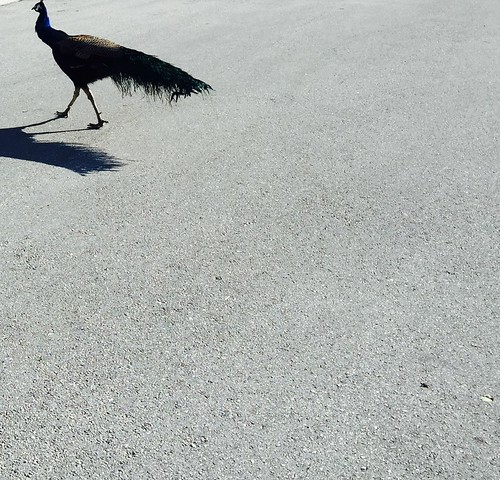
Peacock Crossing the Road
This was about all the traffic I encountered during morning walks.


Although I often dream of traveling around the world, I don't have to dream to be an explorer in my own backyard. Here are a few places I discovered while exploring on foot, some which, ironically, were the homes of famous world travelers.

CHINESE BRIDGE AT DEERING ESTATE

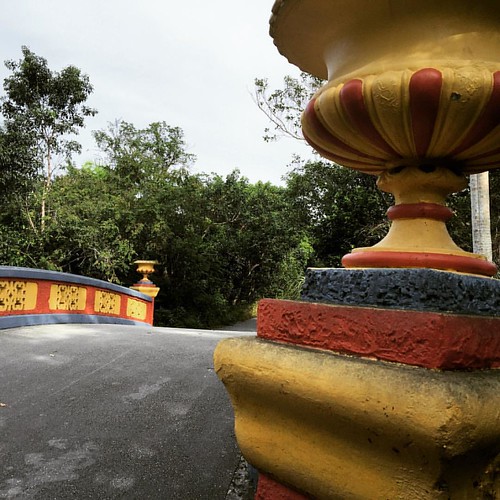
Chinese bridge at Charles Deering Estate
Chinese Bridge at the Deering Estate.


The most well-known historic site in Palmetto Bay is The Deering Estate, which is on the National Register of Historic Places. The estate was once the home of Charles Deering, a wealthy businessman and art collector, whose brother, James Deering, built the famous Vizcaya estate further north along Miami's shore line.

The estate, which I had visited a few times before my most recent sojourn in Palmetto Bay -- is well-known for its cultural significance. But it's the undeveloped environment surrounding the estate that has cast many a spell on me. A few years ago, I took sunrise yoga classes at the estate's visitor's center. We practiced in a room with glass walls separating us from the Pine Rockland preserve outside. The experience was magical.

It's no surprise the area is also where archeologists excavated the Cutler Fossil Site, where they found ancient animal and human bones as well as human artifacts.

Last month, when I ambled about the perimeter of the preserve with my friend's daughter, I told her that watching the sun rise through the mist of the forest felt primeval. "What's primeval?" she asked. The observation turned into a a vocabulary lesson for the eight-year old girl. And then I really thought about it: the word "primeval" connotes everything I love about this place: prime, primeval: a land of firsts, of beginnings, of nature untainted by man.

I feel this way for any neighborhood that respects its trees. They speak to me.

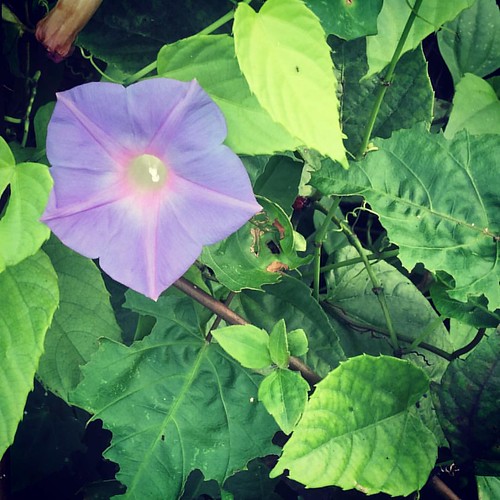
Well hello morning glory!
Morning glory vine on the trail.


One Sunday morning, I discovered a paved pedestrian trail just north of the Deering Estate from which all manner of joggers and cyclists emerged. The trail is parallel to Old Cutler Road and while you can still hear cars rushing by, the scenery is natural and feels completely removed from civilization. This area is also a nature preserve -- part hardwood hammock, part mangrove and all coastal environment -- with Cutler Creek running below the bridge.

That day I just happened to bump into the director of the Deering Estate, who was taking photographs of an endangered plant species. She told me the bridge wasn't supposed to be so colorful, but that those who had restored it thought it should be. Deering built the bridge in 1918 to cross the creek on the way to his home. The Chinese theme reminded him of his role as a Navy officer in Asia.

THALATTA ESTATE

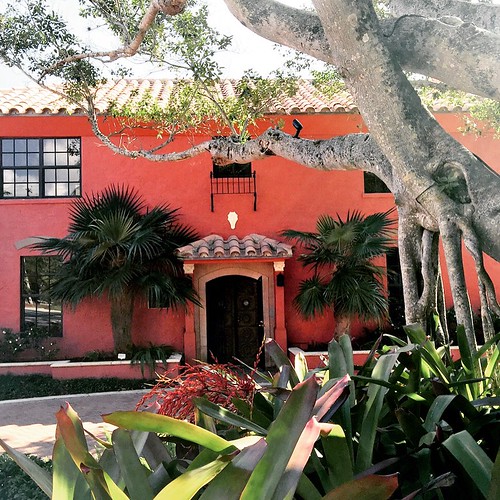
Thalatta Estate
The main house at Thalatta Estate.


When I first set eyes on the coral-colored mansion off Old Cutler Road, I thought it was a private residence off-limits to the public. Little did I know that it was one of five historic bay front homes that dot Miami's coastline which is also the location for neighboring Deering Estate as well as The Kampong, The Barnacle and Vizcaya further north.

One morning, the gate was open and I entered the lush, tropical entrance of the estate. I thought I was crashing a party -- or rather -- the preparation for a wedding party. No one said a word because I wasn't trespassing. I was walking, in fact, inside a public park.

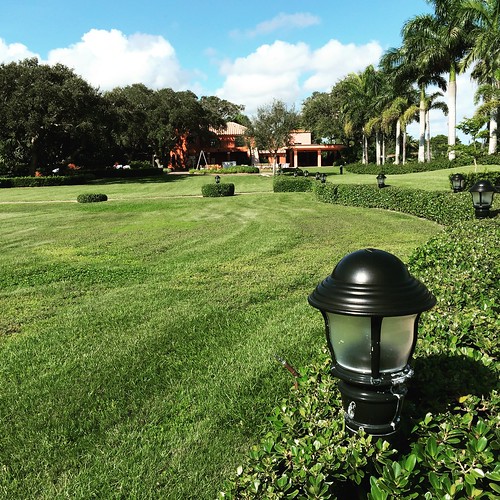
Thalatta Estate
The lawn seemed endless at Thalatta Estate.


Thalatta Estate is an exquisitely preserved 1925 Mediterranean Revival home with an expansive lawn that stretches out to Biscayne Bay. The Connett family built the home that features unobstructed views of the water. The name Thalatta is a Latin variation of the Greek "thalassa," which means "the sea." In 2005, the City of Palmetto Bay acquired the land to prevent further development. I'm glad they did.

For more information, visit The Thalatta Estate.

DEERING POINT PARK

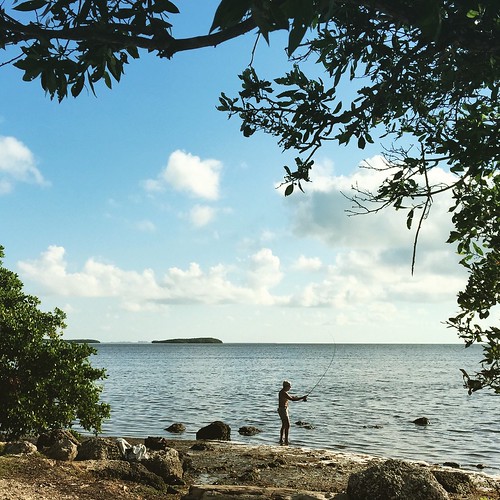
Shore Fishing at Deering Point
My kinda relaxation. Shore fishing on Biscayne Bay at Deering Point.


This small park is part of the Deering Estate and sits in between the Deering Estate and Thalatta Estate along the C-100 drainage canal. Deering Point is a great spot to launch a canoe or kayak.  Although there isn't much here, it's a great spot to enjoy a view of the bay among some native plants and catch sight of some herons, egrets and other birds.

At Palmetto Bay, my eyes saw a different kind of beautiful. See more photos on Flickr.

Wednesday, November 04, 2015

New Tropic: The Land of Water and Honey

well-of-ancient-mysteries-miami-brickell
Yours truly drinking water from the Well of Ancient Mysteries in Brickell.

My wordsmith adventures continue over at The New Tropic, where I've penned two articles -- since you last read about the now famous Miami schlep -- that move away from the topic of transit and are dear to my nature girl heart.

In October, I wrote a story about Ishmael Bermudez, discoverer and keeper of an ancient well located in the heart of metropolitan Brickell. After interviewing Bermudez, who begged me to tell his "truth," the well seemed more like an oracle than an archeological curiosity: are we killing ourselves by not caring for the environment? Read more at The Well of Ancient Mysteries.

Bees are dying, too, but luckily there are still enough to pollinate about ⅓ of the plants that make up our diet or feed the animals we eat. And plus, there's always that delicious honey. Blame it on the almonds: an intense investigation ensued when I heard a beekeeper say that California depended on Miami's bees -- all stemming from my obvious question: "Why would California want anything from Miami?"

Many of your South Florida neighbors go gaga about bees. You should, too. I certainly did, which is why I sent my editor a Russian novel instead of a feature ... which she very wisely abridged. Read more at Who's Saving Miami's Bees?

Wednesday, December 03, 2014

Who Says White Fish Can't Jump?

Robbie's Marina, Islamorada
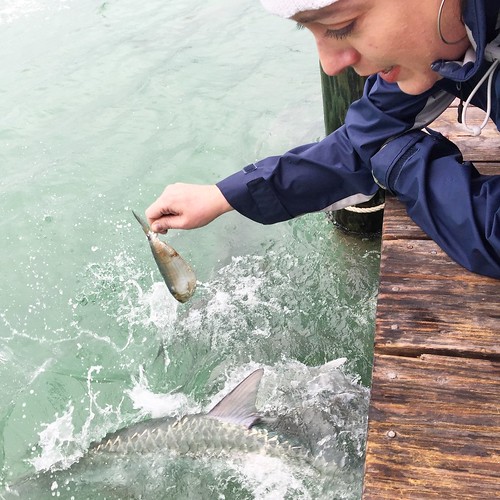
Here little fishy, here!


What weighs more than an average adult human and jumps oh so very high? If you guessed LeBron James, guess again.

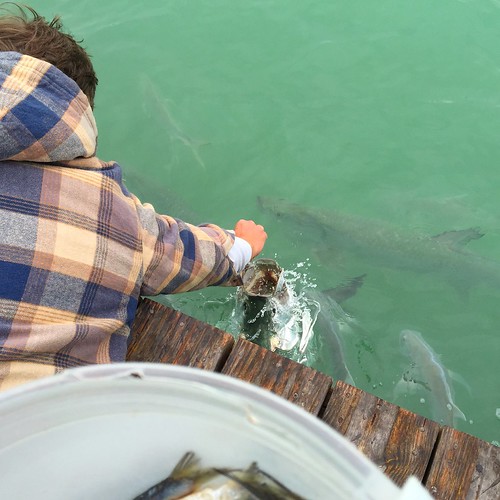
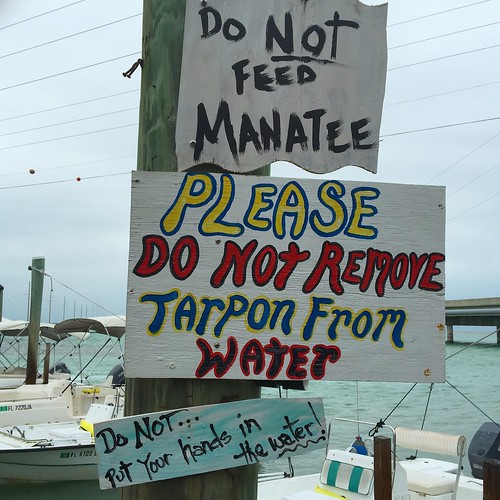
Behold Megalops atlanticus, a.k.a. tarpon or the Silver King of the flats, so named because of its large, silver scales. In Islamorada -- well known as the sports fishing capital of the world -- you don't need a rod and reel to witness the strength of these finny creatures. Instead, feed them by hand!

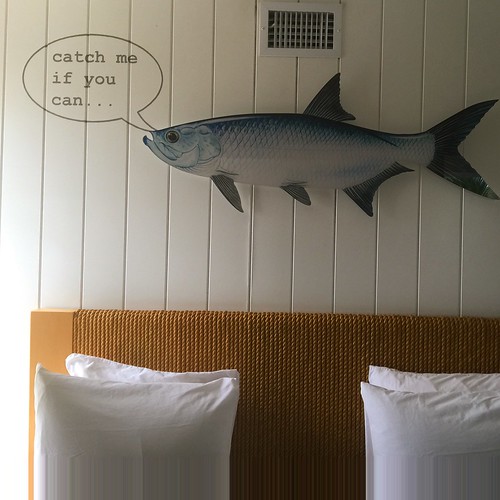
Postcard Inn at Holiday Isle, Islamorada
Tarpon are ubiquitous in Islamorada. At the Postcard Inn at Holiday Isle, you'll even sleep next to one.

In my angling adventures, I've felt this strong fish swim like a speeding Mac truck at the end of a screeching line. They run like mad and jump high at which point every fishing guide will tell you to "bow to the tarpon" -- drop the rod tip so the line goes slack and doesn't snap.

Fishing technique aside, you should bow to this royal highness of Florida's backcountry. Not only has this majestic fish been roaming our coastal waters since prehistoric times, in theory, a leaping tarpon could also do some serious damage.

A couple of years ago, during the World's Richest Tarpon Tournament in Boca Grande, I almost got clobbered by a bounding 200-pounder. The only thing between us was the hull.

Extreme angler Jeremy Wade even researched a documented case about a fisherman who died after a run in with a "killer torpedo" in Central America. The poor guy was fishing in a canoe. Thank goodness for monohulls, although Wade dared to catch his tarpon on fly rod in an inflatable craft.

But tarpon are no river monsters and have no appetite for humans. Hand-feeding them is no more dangerous than giving a bone to your pet Fido. Tarpon aren't toothy, so they can't really bite you. Their big mouths are packed with tiny, densely packed teeth, giving the inside of the mouth a sandpaper-like texture.

Tarpon are simply eating machines who will jump for food.

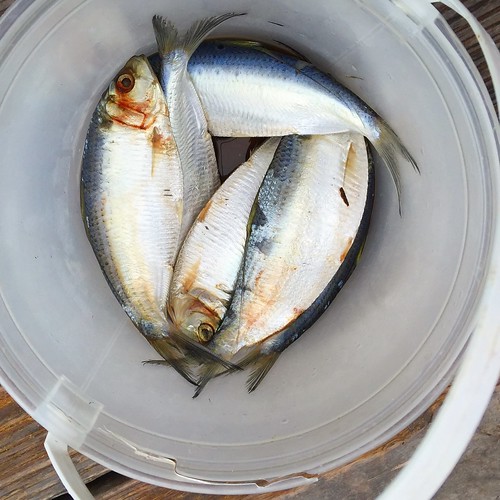
And jump they will at Robbie's Marina in the Florida Keys, where you can see hungry tarpon leap into the air with only one aim in mind: to snatch baitfish from your hands. You'll offer the tarpon some delicacy du jour from a bucket, perhaps mullet or threadfin herring, which was on the menu the day I visited Robbie's mid-November.

The clever tarpon know that there's a free lunch at Robbie's. Staff at the marina recognize return "restaurant" guests by their unique markings.

Like a gang of freeloaders, Jack Crevalles also wait for a complimentary meal, but they circle swiftly under the dock as if anticipating a feeding frenzy. The tarpon are far more relaxed, so you can never quite know when one is going to jump, which adds to the thrill.


Robbie's Marina, Islamorada
For a tarpon, this is first-rate sushi.


Robbie's Marina, Islamorada
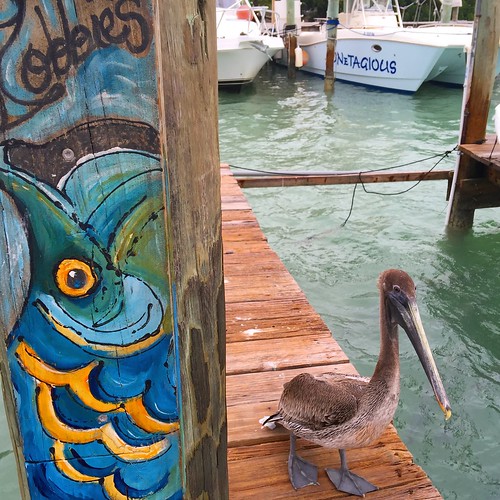
Tarpon aren't the only critters in line for free food.

Robbie's Marina, Islamorada
Kneel down to feed the fish.


Robbie's Marina, Islamorada
Still scratching my head on how anyone could be strong and fast enough to remove a tarpon from the water.

There's more to do than hand-feeding tarpon at Robbie's Marina -- a rustic, laid-back stop along Route 1. Satisfy your own appetite at the Hungry Tarpon, although you'll never see tarpon on the menu. This popular game fish is too bony to eat and a strictly a catch-and-release species, unless you purchase a permit.

Stroll the open-air shops, rent a kayak, take an ecotour, go fishing and more. For more information visit Robbie's Marina.

To learn more about this amazing fish, visit the Florida Fish and Wildlife Commission and the Bonefish and Tarpon Trust.

More photos on Flickr.

See yours truly hand-feed the tarpon in the video below.


FTC DISCLOSURE
For this post, I visited Robbie's as part of a press trip. Opinions my own, as always.

Tuesday, October 28, 2014

Photographer Mac Stone Launches Everglades Book in Miami

mac-stone-everglades-book
A snail kite hunting for food. Photo by Mac Stone.

I hope Marjory Stoneman Douglas was looking down from heaven recently because she’d have been very pleased. The author of River of Grass -- a book that changed the world's perception of the Everglades in the 1940s -- would’ve loved to meet conservation photographer Mac Stone.

Stone grew up in North Central Florida, where he cultivated a love of swamps and practiced the craft of photography. As a teenager, he'd wake up before dawn to capture the perfect light, even if it meant being tardy to school.

His dogged determination didn't end there. Fast forward -- after years of traveling around the world with his camera -- to the Everglades, where Stone trekked through the wilderness, shooting breathtaking images of flora and fauna for his new book, Everglades: America's Wetland.

Stone launched the book last week at the Frost Museum of Science where over 100 guests enjoyed viewing 40 framed prints in the gallery. In the book, art meets science through photographs of birds, reptiles, plants and weather -- all things great and small in the river of grass. The book also features narrative and a list of resources.

mac-stone-book-signing
Mac Stone at the Miami book signing.


mac-stone-snail-kite-photo
Photographer Mac Stone with book cover and print.

I’ve followed Stone and his work on Facebook for months but nothing prepared my eyes for the stunning images seen on a wall instead of a computer screen -- so precise and detailed,  as if graced by the brush of a watercolorist.

To the undiscerning eye, an Everglades panorama may seem flat and boring, but it's really a complex landscape of contradictions, harsh and yet subtle in its vastness. Stone's photography beautifully reveals the many nuances of America's only subtropical wilderness.

During his presentation, Stone often reminded us about a story that needs to be told.

And it's a story that's not so easy to tell -- logistically speaking.

It takes true grit to explore this forbidding landscape. For five years, he ventured into remote areas far from the comforts of civilization. He hung a hammock from a cypress tree for a makeshift campsite that dangled above a lake. He took a close up of a snake, fangs about to attack the lens. He snapped an image of a very toothy alligator -- jaw gaping, tongue covered in mud. He endured sunburn as well as mosquito bites in chest-length black water for days just to capture a snail kite’s hunting technique.

While showing us a slide of his face covered in spider webs he pointed out the obvious: “It’s not glamorous or Indiana Jones.”

For those of us who aren't brave enough to witness the Everglades so intimately in the muck, we can experience Stone's adventure vicariously and travel to places distant not only by miles but also in time. Trails carved where there are no trails, far from the truck-filled highways that intersect the state. Winding rivers that have never seen urban development. Celestial backdrops on flowing water. Nature beating its own primal rhythm.

I’ve experienced this poetic side of the Everglades before. A blanket of peace. The smell of the swamp. The shrill cry of a hawk.

The book brings it all back to me, although I've never ventured so deep into the wild as Stone. Its pages serve as a meditative road map to this once pristine wonder. The camera's lens glimpses an ancient past when plants and animals coexisted without meddling humans. It’s a privileged vantage point: look but don’t touch.

Stone's story is simple yet its impact is profound: if you don’t appreciate it, you won’t protect it. So in a very tangible way, he’s carrying on Marjory Stoneman Douglas’ legacy in the effort to restore, conserve and protect the Everglades.

Stone’s work -- 40 large prints from the book's enormous collection -- will be on display at the Frost Museum of Science until December 4. Half that exhibit will remain until closing date, January 11.

The book launch was also co-presented by the Audubon Florida.

Everglades: America’s Wetland is available wherever books are sold. Support a local bookstore and buy it at Books and Books.


We had an impromptu chat at the book launch. Video on Youtube.

Fortunately, we needn't travel too far to experience and appreciate America's Wetland -- at least from the safety of boardwalks and cemented paths. I recommended the Anhinga Trail and Shark Valley for beginners. Visit Everglades National Park for more information.

Saturday, October 25, 2014

The Fledgling

Photo via Teddy Llovet's Flickr.

A falcon is fledgling on the edge of a dizzying precipice, clumsily flapping its wings. Winds blow hard on the mountaintops, dropping and swirling through the valley below.

As my talons grip the nest, all I see is the infinite sky.

 I'm afraid. Mom’s shrill call echoes in the distance.

And then I woke up.

This morning’s sunrise greeted me with the thought that in two weeks I would celebrate my first birthday without my mother’s living presence on this earth. And although I’ll be 47 years young, it’s perhaps fitting to call it a first birthday.

Every year, she would tell me the story of how I was born. Never why. Just how.


The mundane details: how she packed her hospital bag early to avoid traffic in San Juan; how labor was not as painful as her first three births; how I peed on my brother the first time he held me in his arms; how my ears were pierced; how the delivery doctor told my dad "it's a boy" as a prank.

On the brink of 47, I think I know the “why” now. It’s a why that doesn’t need the clutter of words. It’s a why of soaring through vast open spaces, of being unafraid, of not staying stuck, of peace in the midst of chaos. A why of infinity.

A why of raptor birds perched on cliffs.

“I’m a fledgling too, Maria. I also took a leap into the unknown. Don’t be afraid of living. Don’t be afraid of dying.”

And with those words, my talons let go.

Happy first birthday, mom. It's yours just as much as mine.

Sunday, May 19, 2013

Get Out Your Frying Pan! Lionfish Is What’s For Dinner

lionfish-invasive-species
This beautiful fish is wreaking havoc in our native Florida waters and beyond. Photo courtesy of REEF.

Last month, I attended the First Annual Lionfish Food and Wine Night at Key Largo’s Fish House Encore, hosted by REEF, a grassroots organization devoted to marine conservation. The house was packed at this exclusive gourmet event, where locals and tourists alike were eager to learn about lionfish.

Lionfish are gorgeous, dramatic-looking finny creatures, with elongated spines that jut out from their frames in mottled shades of red, orange, white and black. In water, the spines sway gently in a beguiling dance. Indigenous to the Indo-Pacific, lionfish are prized on this side of the globe as an exotic aquarium species.

It’s nothing personal, but unfortunately, they don’t belong in our coastal waters.

Lionfish Dinner Event in Key Largo
Lad Adkins of REEF lecturing on the marine issues involving lionfish.

Two visually identical species of lionfish were first introduced into the Atlantic via the aquarium trade in the 1980s. The result? Non-native lionfish have invaded waters from the Carolinas to South America, the Caribbean and Gulf of Mexico.

And as one report indicates, they may even be able to handle estuarine environments with lower salinity, including the Loxahatchee River.

Voracious eaters, lionfish also spawn prodigiously, reaching sexual maturity in less than a year, while they feast on over 70 species of fish and many invertebrate species, altering the balance of long-established ecosystems. Lionfish densities can reach as much as 200 adults per acre and a female in the Caribbean can spawn over 2 million eggs per year.

This pretty fish is like the Terminator!

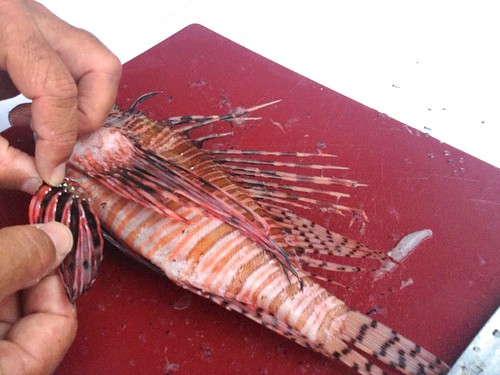
Lionfish have evolved a very clever defense system through their venomous spines, which protect their bodies with a neurotoxin, so they must be handled carefully to avoid stings on human flesh.

Lionfish Dinner Event in Key Largo
The venomous proteins in the spines can be denatured with hot water. Just be careful.


God forbid, but if a lionfish up a Florida river ever seriously hurt a human, we might even get Jeremy Wade of River Monsters to come down here and investigate!

It’s too bad this invasive species isn’t easily harvested by conventional fishing methods such as rod and reel, what with so many other fish in the reefs competing for bait. Maybe they’re just too wily. Also, they can thrive in depths as far as 1000 feet.

They tend to hunker down under structure and like stalking for live bait.

Spearfishing seems to be the best method of capturing lionfish and the Florida Fish and Wildlife Commission has encouraged open season on the possession and harvest of the species. Numerous lionfish derbies for recreational fishermen take place around Florida and other invaded aquatic regions.

A LIONFISH WEEKEND WARRIOR

Deborah Meltzer, owner of a printing business in the Fort Lauderdale area for the last twenty years, is a scuba diver and lady angler who takes her lionfish harvesting seriously. Sex and the Beach spoke on the phone with her about her underwater fishing endeavors offshore ranging from Pompano Beach to Fort Lauderdale accessible reefs.

“I’m more into the catching of them than cooking them,” she said. “I started out getting interested in hunting lobsters and then I took a course in lionfish. It’s not lobster season right now, so I like to go for lionfish since there’s no restriction.”

She admitted that divers can only keep them in check and that they’d never be able to get to them all to curb the population. “That’s how bad the problem is,” she said. “But I do my little part in helping save our reefs from invasive species.”

Because of their dorsal and anal venomous spines, they have no natural predators in this part of the world.

“Bigger fish would have to learn how to eat them,” said Meltzer.

“I’ve heard it’s like a bee sting on steroids,” she said. “Although, I’ve never been stung.”

In addition to a traditional spear, Meltzer sometimes uses nets or a PVC contraption that relies on a trap door to safely carry multiple lionfish underwater, thereby preventing stings.

“It's really important to learn how to handle them” she explained. “So this way you don't feel their powerful venom.”

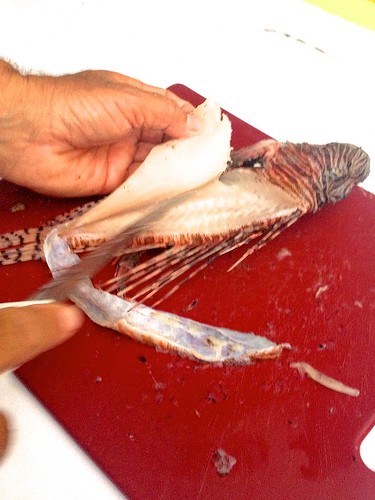
Once the fish are on board and ready for a first mate’s fillet knife, it’s a different story.

“We fillet the larger ones and check their stomach content,” she said. “They eat everything that’s economically important to us and environmentally important to the reef.”

OUT OF THE WATER AND IN THE KITCHEN

Lionfish Dinner Event in Key Largo
Fillet carefully and you've got a tasty dinner.


But back to the Key Largo event.

The best part for fishermen is that once you’ve safely caught and filleted a lionfish, you’ve got a potentially tasty dinner if your culinary skills are up to par. The white flesh is tender, akin to hogfish, without that “fishy” scent and flavor we associate with species like tuna.

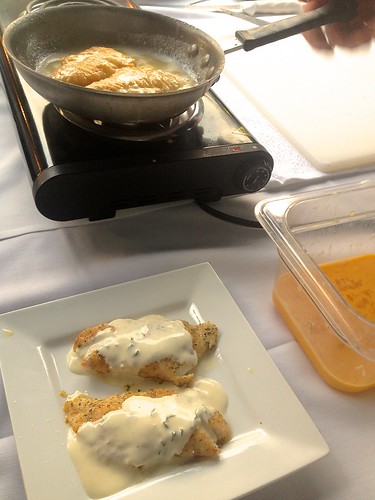
The fish fillet lends itself beautifully to a traditional wine, butter, shallots and cream sauce preparation with a lightly floured, egg-washed fillet.

Lionfish Dinner Event in Key Largo
Straight out of Escoffier. A traditional preparation. Julia Child would approve ... I think.


My favorite dish at the Fish House Encore was the Sea Salted Cured Lionfish served with heirloom tomatoes, red-onions, cilantro and drizzled with olive oil.

The second course was also delicious. The lionfish was encrusted with fried red onions and Japanese breadcrumbs, baked in the oven and served with a sweet and sour sauce over arugula salad.

I wasn’t too happy with the other two courses and besides, I was rather full by then. I’d avoid mixing bacon with the lionfish or anything too strong in scent, smoky or chewy in texture. Think white wines and light flavors or textures, flash preparations with minimal time in the pan to preserve the tenderness of the flesh.

Next time you go to eat fish at a Florida restaurant, ask if they serve lionfish. Or better yet, ask your local fishmonger if they’ve got any on ice. A bounty of recipes, which you can apply to similar fish like snapper or grouper, is available in the The Lionfish Cookbook, authored by Tricia Ferguson and Lad Adkins. Beautifully photographed, the book is a must for any home chef interest in reading simple yet varied preparations for fish. Proceeds from book sales will continue to support marine conservation and lionfish research.

RESOURCES

Reef.org

Florida Fish and Wildlife Commission

Lionfish Derbies

Lionfish Cookbook

Restaurants Serving Lionfish (to date)

Loxahatchee River Study

National Geographic post on sharks being taught to eat lionfish in Roatan, Belize

Follow @killthelionfish on Twitter for latest news on lionfish events and issues.

Monday, December 10, 2012

Fishing Adventures in Florida’s Ten Thousand Islands

Fishing Reel and Tackle
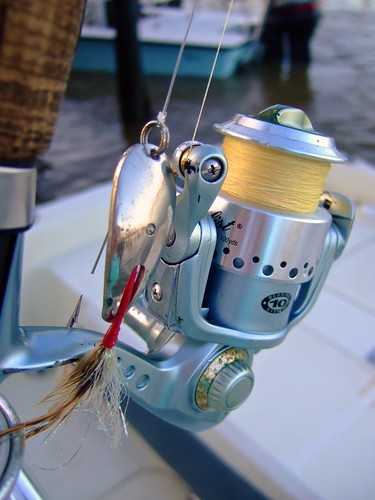
Fishing porn.

Since backcountry is my favorite type of fishing, I couldn’t resist the opportunity for a full immersion weekend in the Everglades region of Florida’s gulf coast with Ladies, Let’s Go Fishing, which took place this past October. (As you may recall, I attended a similar seminar last year in Islamorada and fished with Captain Bob Jones.)

I set out before dawn, westward bound on Tamiami Trail.  Just after the sun rose and the mist lifted over the river of grass, I arrived at Port of the Islands, a resort that seems to be in the middle of nowhere, situated in between Marco Island and Everglades City, with water access to the 10,000 Islands via the 3.5 mile Faka Union Canal.

Pavillion Key, 10,000 Islands, Gulf of Mexico
A maze of islands makes up this area of the gulf.  Port of the Islands is just off Tamiami Trail. I fished out of Chokoloskee.


The 10,000 Islands are particularly special for me.

I know this place. Oh yeah.

Years ago, Sir Fish A Lot and I would trailer our Hewes Bonefisher out here. We called her the Cyan, because of the color of her hull. One day, on the way back from the pristine islands where, thankfully, there is no human civilization, our outboard engine failed mid-journey in the Faka Union Canal.

We went into survivor mode, long before there was even a TV show by that name. We were alone here -- no boat traffic, no cellphones.  And the radio? Battery had run out.

Every dog has his day and boy, this really just wasn’t our day.  Nothing seemed to be working.

Poor Sir Fish A Lot did his best. First, he tried to pole us back to port while standing on the flats boat platform, but the water was too deep and the tide was outgoing, current flowing against us -- a Herculean task, to say the least.

Then we lost the pole close to the banks of the channel. He jumped into the muddy oyster banks on the edge and waist-deep in the water, threw the anchor forward to drag the boat forward while I steered. 

Under the hazy colors of dusk, gators were floating nearby, mosquitoes were buzzing and biting, flies the size of quarters were crash-landing on our faces, but he remained stoic, steadily dragging the boat forward until – gasp! – we lost the anchor.

We drifted aimlessly along the current for what seemed like an eternity.

And then a miracle happened.

Another boat was also returning to port, with a biblical inscription about fishermen painted onto the hull. 

The kind gentlemen on board towed us back to safety. I'm not particularly religious,  but I'm pretty sure this is what Jesus would have done.

Once back at Port of the the Islands, Sir Fish A Lot and I fell utterly exhausted into bed, too tired to even consider supper.  A day of complete frustration, with no fish caught, but certainly much courage and pluck mustered.

We may have not stayed a couple forever, but I do count this as one day where I thought we could get through anything.

So, dear readers, imagine my connection to Port of the Islands when I arrived at the seminar!

The first day at Ladies, Let’s Go Fishing was chock full of learning through a no-stress, pleasant series of lectures and hands-on mini-workshops. About 40 women attended talks on backcountry fishing led by local guides, as well as sessions by representatives from the Florida Fish and Wildlife Commission, who discussed conservation policies. Our afternoon “skill stations” included de-hooking fish, venting fish, casting light tackle, net casting, boat handling, knot tying and even kayak fishing, among other techniques.

Ladies, Let's Go Fishing - Everglades Seminar
To the left, Barbara Evans, a licensed Captain, practicing ultralight rod casting techniques with Mary Fink of Island Girl Charters, to the right.

Kayak Fishing
Jean McElroy, the redhead on the left, is pro staff at Ocean Kayak in Palm Beach County and a master at kayak fishing. Pretty ballsy if you ask me!

Ladies, Let's Go Fishing - Everglades Seminar
Florida Fish and Wildlife Commission representatives taught us much about conservation and proper handling of fish.


Ladies, Let's Go Fishing - Everglades Seminar
A participant learning how to tie a clinch knot from Captain Mark Worley. I tried it as well, but already forgot.  I need to keep fishing lines and knot books by the can -- the most recommended way of practicing.

Betty Bauman, founder of Ladies, Let’s Go Fishing, demonstrated the proper reeling technique for catching large game fish:  rod holder belt on, squat, straighten your back, let the fish run then reel in when it relaxes.

I raised my hand. “Betty, what happens when the fish feels like a Mac truck at the end of the line?” I asked. “I hooked a beast two weeks ago and couldn’t even wind the reel.”

“Just practice, Maria.” She replied.

And practice I would. I didn’t know what I was in for.

Ladies, Let's Go Fishing - Everglades Seminar
It's all about physics.  Even a petite, slim lady can catch a big fish.

The next day, I was up at 4 am to get ready for fishing with Betty, her husband, Captain Chuck – the inspiration behind the “no-yelling” school of fishing – and a photographer from a gulf coast newspaper. Other ladies went fishing as well, but with different guides, some even on kayaks.

The journey seemed long although we weren’t far from the marina in Chokoloskee. I was so eager to be on the water with rod in hand.

So was Captain Chuck. Just after sunrise, we finally blazed across the flats of the 10,000 Islands, remote waters he knows intimately.

I knew it was going to be a good day when after anchoring off Pavillion Key, Captain Chuck rigged a spinning rod with a gold spoon and -- bam! -- first cast resulted in a keeper redfish, which I hooked and landed.  Folks, for those of you who aren’t familiar with fishing in the backcountry, this rarely, if ever happens. First cast? No way.

Redfish Fishing - Everglades and 10,000 Islands
Not bad for the first catch of the day.


Pavilion Key, 10,000 Islands, Gulf of Mexico
Captain Chuck cast netting for pilchards around pristine Pavillion Key, which is close to the wide open waters of the Gulf of Mexico. We also saw a few campers who had reached the remote area by canoe.

We spent much of the morning fishing and cast netting along the shore of the key for bait. In the meantime, I hooked what was probably a ray, which gave me a good fight. Captain Chuck didn’t let me land it because he said it would spook other fish.

When we finally had enough ladyfish in the live well, we headed to an area more densely populated with mangrove islands.

“Now let’s do some real fishing,” said Captain Chuck.

We cast for snook along the mangroves but didn’t have much luck.  “I wouldn’t have picked this day for this kind of fishing,” Captain Chuck explained. “Tides and conditions aren’t right.”


But wherever we anchored, Captain Chuck put out a conventional reel with a ladyfish on the hook for me, while we fished with spinning rods along the shores. Twice “my rod” squealed and twice a big one got away.


Rabbit Key - 10,000 Islands
One of the spots where we fished. Camping is an option at Rabbit Key, part of the Everglades National Park system.


By 3:30 PM, when we were obligated to return to port, Captain Chuck asked us to stop casting. As we were getting organized to speed across the flats, my rod screeched.

“Grab it, Maria! Grab it!” said Captain Chuck.

In that moment of haste, my heart started pounding. Fishing can be incredibly boring, followed by rushes of adrenaline.

“Could this be it?” I thought.

What I felt at the end of that line was similar to whatever I had hooked in Cape Sable. A mammoth that could speed like it was racing at the Indianapolis 500 yet also become a dead weight, a concrete boulder.

It never jumped.

“It’s not a tarpon,” said Captain Chuck. “Keep reeling.”


There was no rod belt holder on board. I placed the butt end of the rod on my thighs near my crotch and prepared for what I knew would be a strenuous experience for my body. Within minutes, biceps were burning, hands felt feeble, fingers weak.

Something funny happens when you attempt to land a big fish. You wonder: why the hell did I sign up for this? Am I crazy?

I remembered my experience near Cape Sable and what Betty had taught us the day before about catching big fish.

The fish ran. I let it run. The fish stopped, I reeled in as hard as I could. My rod was constantly bent.

About 15 minutes into the fight, Betty asked me if I was OK. I had started inhaling and exhaling deeply -- my yoga practice in service here, to focus and be present in the moment, to get past the pain in my muscles. Think of it like a Lamaze exercise for a kind of labor that isn’t about giving birth.

Then Captain Chuck chimed in. “You can let it go if you need to.”


I didn’t miss a beat.

“Captain Chuck, I still have energy left in me. I’m not going to give up.”

“Atta girl! That’s what I want to hear!” he said joyfully. His face lit up. “You’re doing such a great job!”

That did it for me. No yelling here. And no way in hell was I going to give up. I was in the zone.

About another 15 minutes passed. Eventually, we spotted a 6-foot long fish on the surface. Captain Chuck grabbed the leader and and let the line snap.  


“That was a 200 pound bull shark,” he said as he patted me on the back. “I am so proud of you, Maria.  Really. Very, very proud of you.”

My body felt a huge sense of relief. My spirit soared. It was almost surreal. Had I really done this?

Captain Chuck is the kind of old salt who will tell it to you like it is. There's no fussy, girly nonsense on his boat. He’ll be honest when something isn’t right so you can get it right.

It’s not that I was fishing for approval from a fatherly figure. It just happened. I made it happen. I manifested this insane desire to practice the sport. And although I had received instruction and encouragement from mentors, when it came down to battle, I did it all with my own hands.

I really did it.

I caught and released my first big shark.

“This was the big one that didn’t get away!” I exclaimed. “Whew!”

Photo courtesy of News-Press.com via Lindsay Terry.  Click here to read the full article.

As we headed back to Chokoloskee, the islands took on a mystical quality behind my polarized sunglasses, which intensify shades of green and blue. Maybe it was the lactic acid in my muscles or maybe it was my mind trying to fathom what I had just accomplished.

 And then I reminisced about Sir Fish A Lot, finding ourselves astray in the Faka Union Canal and how he had been an inspiration for me, showing dogged resolve to get us through a rough patch.

Fishing is never just about the fish. It’s a test of the faith and strength in yourself.

Although I really, truly should practice tying my knots.

RESOURCES

Visit Ladies, Let's Go Fishing to learn more about their education programs, which are open to all women -- novice and experienced alike.  It's not just about fishing skills; participants also enjoy great camaraderie. To inquire about fishing or camping excursions with Captain Chuck, please utilize the contact form on the website, which also features a curated list fishing guides in the Southwest area of Florida.  More photos from the weekend seminar on Flickr.

As always, I encourage anglers to be educated and practice catch and release. Know your regulations and only keep what you're going to eat within a day or two.  Learn more about fishing rules at the Florida Fish and Wildlife Commission.

National Geographic has a good spread on bull sharks.

Learn how to dehook a fish.

Friday, November 02, 2012

The Big One That Got Away

everglades national park fishing florida bay
Heaven for any Florida back country angler.  Frank Key near Flamingo.


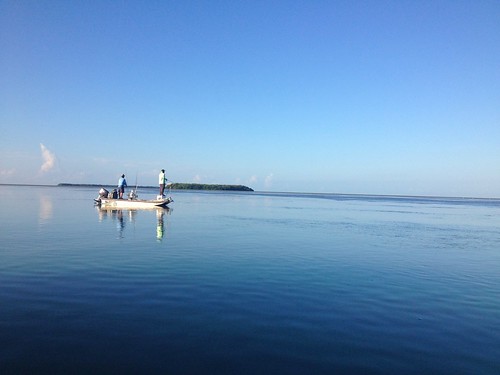
Last month, I made a pilgrimage back to Everglades National Park where I first got hooked on fishing.  It had been a over a decade since I experienced the pristine and uncluttered environment of Florida Bay west of the Florida Keys, where I used to pore over navigation charts while Sir Fish A Lot steered our flats boat. I recognized the keys, channels and mazes of mangroves immediately, as if they were long lost friends.  I breathed a sigh of relief. I was home.

I met my guide, Captain Ted Wilson, just before dawn at Bud N' Mary's Marina in Islamorada.  I knew I was in good hands as he has been fishing and exploring the same body of water for 19 years and guiding professionally for 17.  He knows this vast expanse of skinny waters intimately.  And it's no ordinary body of water -- cradled by the Atlantic to the east and the Gulf of Mexico to the west, Florida Bay is a unique ecosystem, with fresh water flowing in from the north.

After about twenty minutes cruising west, we stopped close to a mangrove with good current to cast net some bait.  And then I was reminded why I love fishing the area so much; it's not just about the fish, but also about witnessing nature first-hand, away from the high-energy distractions of urban Miami.

Man-o-war birds, cormorants and pelicans were gathered around their nests, waking up to the sun's gentle morning light.

Cast Netting for Live Bait florida bay captain ted wilson
Cast netting for pilchards in Florida Bay early in the morning.


florida keys birds nesting rookery mangrove
Scattered throughout Florida Bay and the park, these mangroves support much wildlife.


As we approached the Flamingo area of the park, we also passed by Frank Key where we tried to net more bait -- my guide actually gave me a mini-lesson in handling a boat! -- but the water was too shallow. We did spook some large sting rays that we could see clearly over the thick grass beds.

In 2005, Hurricane Wilma denuded the west side of the key and wiped out nesting areas for Roseate Spoonbills, so boat traffic and fishing is prohibited around the periphery of the key from November to April.

Near Flamingo, we looked for diving sea terns -- a sign that ladyfish might also be feeding -- so we deployed light tackle. Captain Wilson and I had fun casting for ladyfish although we did manage to pull up a few slimy, grunting catfish.  He told me about another client from Louisiana who would dehook them with his own hands, even though their spiny dorsal fins can prick skin, resulting in painful injury.

With a rod in my hand, all was aligned in the universe -- that moment when you know you're doing exactly what you love and your heart is in it completely.  That's what fishing does for me; it forces me to be in the present. I was beginning to connect with my tackle. I was beginning to bond with nature.  I was warming up unconsciously for what I never imagined would be in store for me this day.

After Captain Wilson was satisfied with amount of bait in the live well, we headed further west to East Cape Sable, which is closer to the Gulf of Mexico.  Here we saw dozens of majestic loggerhead turtles with sandy Cape Sable beach as a stunning backdrop.

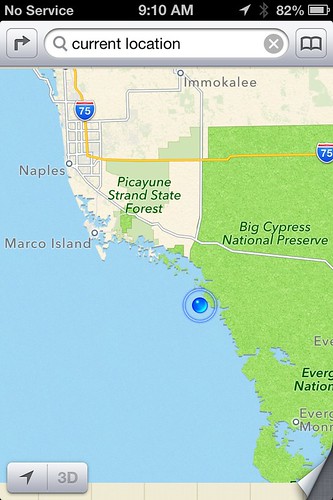
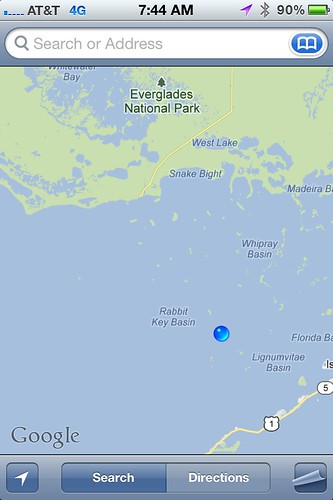
Location Coordinates in Florida Bay
Even though we were out in the middle of nowhere, I managed to get my iPhone  to work.


We saw some tarpon rolling, so Captain Wilson quickly prepared the tackle. Using 30# conventional gear, we hooked a live ladyfish across the nose on a 7/0 Owner hook and then drifted it back behind a float with 10 feet of 100-pound monofilament for leader.  Within minutes, the much anticipated screech of the line told me I had hooked a tarpon.

Captain Wilson reminded me to "bow to the king," leaving some slack in the line when the fish jumped.  I'll admit I was a little nervous, although my guide was an excellent teacher. But with an estimated 80 pound tarpon at the end of my line, the heart started racing!  The silver king is a formidable fish and alas, after about five minutes, it spit the hook out on a jump.

We kept trying for tarpon but sharks were eating up the ladyfish bait and cutting the monofilament leader, so Captain Wilson put out an additional rod with steel leader and an ounce of lead with half a ladyfish on the bottom.

I had told Captain Wilson that I had always wanted to catch a big one and boy, I should be careful what I wish for.  I hooked two fish, the first was most likely a Black Tip or Bull Shark that managed to shear through the metal leader within minutes.

And then arrived my come to Jesus moment.

Another screech on the line, a rod in my hand and what felt like a Mac truck speeding away from the boat. What the hell was I thinking? Could I physically handle this challenge?  How would I muster up the strength? It didn't take long for my right bicep and left forearm muscles to start burning. I'm no tiny girl, but whatever was on the end of that line was decidedly bigger than me and that's over 200 pounds.

At one point, Captain Wilson put a rod holder belt on me and I remembered what Betty Bauman of Ladies, Let's Go Fishing taught me about reeling in big fish -- squat, tuck your tailbone in and don't muscle it.  But I was really struggling and doubting myself at this point. Captain Wilson coached me again and reminded me to not work the reel so hard. I let the fish run and then reeled in the line, but it was never easy. I had connected with a creature to be respected, monstrous in size.

Half an hour into this fight, when I had the fish so close to the boat, when my stamina was all but gone, it simply spit the hook and let go. We never saw it.

Sawfish
Not photographing my fish is the best conservation policy.  But here's what a sawfish looks like; the species has long rostrum.  Photo by p medved via Flickr.


Exhausted yet exhilarated, I wasn't sure what to feel.  It was frustrating, to be sure, but it was also a fair fight between woman and beautiful beast.  And even if I never spotted the amazing creature, I had done something I didn't know I was capable of doing, something I had never done before.  I may have "lost" the fish, but I "found" me.

What was on the end of that line? Captain Wilson made an educated guess. Based on the fish's behavior it was most likely a colossal sawfish of about 400 pounds.  We were targeting shark but sawfish do roam these waters.  Sawfish are a protected species and I was relieved that the fish let go without a hook.

Captain Wilson asked me if I wanted to try again but I was beat and wanted to switch to light tackle, so we headed over to Snake Bight, where the tide was low.  Roseate spoonbills were feeding in the shallow water.  A common mirage effect on the flats makes the birds look like towering giants from a distance.  Without much wind, the dead silence of the Everglades magnifies the high-pitched squeal of an osprey or the honk of a heron.  These are sounds I love.

We poled to the mangroves and cast for snook, using 7-foot spinning outfits loaded with 15# braided line, 3 feet of 30-pound flourocarbon for leader and 2/0 Owner hooks with live pilchards.  We caught and released several juvenile snook, which was a good indication that snook populations were bouncing back after the winter freeze two years ago that killed so many fish.

Captain Ted Wilson Poling the Boat in Snake Bight at Everglades National Park
Poling in the shallow waters of Snake Bight.

Captain Ted Wilson with a Juvenile Snook in Everglades National Park
It's good to see snook populations on the rise.  All fish were released safely using a dehooker.

On the way back to the marina, I reflected on how I had just spent half a day in one of my most favorite places in the world, the Everglades, my heart soothed by this contact with nature.  Even though fishing happens on the water, it's a very grounding experience. I was immensely grateful for the physical battle that taught me spiritually to trust my own strength and determination. The fish is a great and humbling teacher.

Flats Fishing Buff Fashion
Fishing fashion isn't particularly sexy but it's good to get back to port with minimal sun and wind damage to the skin.

ABOUT THE FISHING GUIDE

Fishing is in Captain Ted Wilson's blood -- he has been doing it since he was a kid. He grew up in Florida and moved to the Florida Keys after graduating from the University of Florida.  This fishing guide lives in Islamorada with his wife and five-year old daughter. The little one is already learning to be a great angler and participates in kids' tournaments.  In fact, a week after my own trip, she won Championship Angler in her age group for the Keys Kids Fishing Derby.

Find Captain Ted Wilson online for additional information about fishing and nature tours.

RESOURCES

Learn more about Sawfish protection and tagging studies at Florida Fish and Wildlife Commission. If you do catch and release one, report it for scientific research.

Monday, October 15, 2012

It's Never Just About the Fish


bull shark
Photo by Pterantula via Flickr.


I am still trying to wrap my mind around what happened yesterday. Sure, I hooked, fought and released a bull shark estimated at 200 pounds, but there was a revelation when subjecting my body to this, my body pressed into service of this endeavor, maintaining the mental focus and willpower to see it through.

This was woman-against-beast -- or perhaps more appropriately -- reeling the beast-within to a perfect moment of surrender where two forces of nature bow to their own strengths and weaknesses. Through that thin, braided line, I connected with the fish as it taught me something about a part of myself I don't normally tap into. It was an awkward dance, to be sure -- my biceps burned, my spine lit up, my thighs tightened -- all to reel up this formidable animal.

Somehow, I managed. I feel grateful for this battle and I thank the shark, because it had to fight my courage and my body, which is nothing frail or tiny.

For me, fishing is a metaphor of life, of not giving up and of eternal patience, of communicating with this sheer, literal force that pushes me out of my comfort zones.

Sure, I had a big fish at the end of my line yesterday. But what I really caught was my strength within.

This fishing adventure took place in the 10,000 Islands off of Chokoloskee, Florida.

Tuesday, July 03, 2012

Gus the Grouper: More Than Just A Fish: Interview with Jeremy Wade

The third and final part of a series on angling and conservation in Florida focused on the Goliath Grouper. Inspired by Jeremy Wade’s by-catch at Fort Pierce Inlet, which was broadcast on River Monsters, the series looks at many different ways of interpreting this fish and its relationship to human interests. Click here for all posts labeled “gus the grouper.”

goliath-grouper-doug-kahle-underwater-photography
A magnificent Goliath photographed by master underwater photographer Doug Kahle.

HOW GUS GOT HIS NAME

"His name is Gus," Don Voss said.  The Vietnam veteran turned diver and sailor, spoke in a gruff voice but was sweet in his demeanor. "Yeah, I recognize the fish. I saw him around the time Jeremy caught him. He's still around."

Goliath groupers have a mottled exterior with particular markings that make them recognizable from other fish of the same species, so it's not unusual that Voss knew the fish when he saw him on TV. Voss, who was recently nominated for an Ocean Heroes award, spends a considerable amount of time underwater; he organizes diving trips during slack tide to remove marine debris from Fort Pierce and surrounding inlets through the Marine Cleanup Initiative.

SO WHAT HAPPENED?

jeremy-wade-goliath-grouper-florida
The controversial photo that frustrated many Florida conservationists.

A group of conservation-minded divers became upset when River Monsters broadcasted an accidental by-catch of a Goliath grouper near Fort Pierce Inlet.  The catch took place last summer when Wade returned to Florida to film a targeted bull shark catch in the Indian River Lagoon for the season four premiere, American Killers.  (Watch the segment at Animal Planet online.)

I learned about the issue through the River Monsters Facebook page. (River Monsters on Facebook has since blocked its wall, so I cannot link to the original discussion.)

I researched the matter and was mortified.  Here I am preaching conservation and I had previously posted a photo of Jeremy Wade with Gus above the water; possessing the fish in such a manner is illegal according to the Florida Fish and Wildlife Commission (FWC). The problem was not the catch itself -- a by-catch is often unavoidable -- it was how the fish was handled for the camera and how no information was immediately available to audiences in the show's footnotes about the sensitive status of the species.

To be fair, Animal Planet does state that Goliath groupers are "fully protected" on the Discovery Channel website, but there is no reference to FWC regulations about handling the fish once it is caught.   Yet titling a video "How to Catch a Goliath Grouper" is potentially misleading to a naive public.

GOLIATH GROUPER REGULATIONS

Goliath groupers, formerly known as Jewfish, grow to monumental size and were nearly wiped out in the 20th century from careless fisheries management. Goliaths congregate when they spawn and anglers would slaughter entire schools.  Overfishing nearly led to extinction.

A former trophy fish, the Goliath grouper is now a protected species on the federal and state level. You can catch a Goliath, but possession and harvest of the fish illegal.  The sheer weight of the fish can cause its internal organs to collapse when subject to gravity.  As well,  the air bladder of a grouper will expand when raised to the surface from deep water, though many Goliaths are caught in relatively shallow areas.  If you catch one, try your best to release the hook while keeping the fish submerged underwater.

In practice though, a fisherman sometimes has to decide immediately on behalf of the animal's welfare whether it's better to cut the line at the leader, leaving the hook in the mouth, or to bring the fish above water in order to release the hook -- neither are easy tasks if the fish is still fighting.

And then there's a matter of photos. You're not supposed to mess with Goliaths unless you have a special license for scientific research or filming purposes. As stated on the FWC website: "The taking of photographs after removal of hooks and posing for pictures with goliaths is not considered an immediate release of the fish."

I had to ask myself: could Jeremy Wade, an angler whom I respect, who inspires many folks with his adventures -- some even consider him a mentor of sorts -- really have egregiously violated an FWC regulation on an internationally broadcast TVseries?

So I started to make a few phone calls.  Again, the issue wasn't that he caught one -- that happened by accident while he was targeting a bull shark. The matter was that River Monsters broadcast the catch without footnoting or explaining the protected status of this species with greater detail.  In the photo, it's obvious that the fish is above water.  As well, according to an FWC staffer I spoke to who wished to remain anonymous, no one from the production team had applied for a special research or filming license.

And this from a renown angler who promotes conservation as well as catch and release. In the Goliath Tigerfish episode shot in Africa, Wade seems very remorse about an impressive specimen that perished after a fight.  Wade doesn't come across as a Hemingway macho kind of angler.  Behind the toughened face of this 50-something explorer, there's a sensitive conservationist.

As an angler, I can relate. The attraction to the sport is rather perverse and contradictory. Let's face it, you're basically harassing a creature that wants nothing to do with you.  The fish serves no purpose unless you're going to eat it, yet you want to thank the fish because it fulfills your quest for the hunt and the story. And you certainly don't want to kill it, even though you risk a fish's life every time you cast a line in the water.

I know. That's screwed up.

Still, I expected more from Jeremy Wade. I was disappointed. And the fact that it happened in Florida, my own backyard, didn't make me happy.

THE RESEARCH

epinephelus-itajara-goliath-grouper
Epinephelus itajara aka Goliath Grouper. Photo by Albert Kok via Creative Commons.

I spoke with local divers, fishing guides, scientists, historians, FWC and even Wade himself on the subject.

I also spoke to Mark Palmer, the guide who took Jeremy Wade out fishing that fateful night when Gus bit into bait that was intended for a bull shark.  Palmer, a former shark fishing legend in semi-retirement, assured me everything was done by the books.  "You should see my fishing team," he said. "We're like a Nascar pit stop. We catch and release very quickly. The River Monsters film crew did the same."

Throughout many conversations, fishing guides complained about divers and divers complained about anglers.  I learned about political lobbies that affect commercial fisherman as well as recreational ones. Some fisherman were upset about the restrictions imposed by FWC, claiming that Goliaths are gluttonous predators who decimate populations of their prey like lobster and snapper.

A no-fishing zone in the Dry Tortugas -- a group of islands 70 miles off Key West, proves otherwise, according to scuba instructor Amy Lesh. Populations thrive without invasive species and human intervention. "The no-take zone in the Tortugas is protected marine area," she told me over the phone. "Fish live in balance.  Groupers, snappers and lobsters co-exist with no one species wiping out the other. I've seen it with my own eyes."

After the phone calls, emails were exchanged with Discovery Channel and Icon Film staff (Icon Films, a production company in Bristol, England, produces River Monsters).  If I were to really get into this, I'd have not one blog post but an entire book.  So I'm going to try to get down to brass tacks in this already long post.

In the middle of all this mess is Gus, of course. He has no idea.

THE PLEASURE OF SPORT FISHING COMES WITH RESPONSIBILITY

Celebrity anglers like Jeremy Wade have great influence. But when something like this slides off the hook (excuse the terrible pun), he loses credibility. He certainly did lose respect from most of the divers I spoke to, although to be fair, many of them had only seen this one particular segment about Gus.

But the diving community makes a great point.  Goliath groupers aren't killers. They're gentle giants.  I can see why they took exception to Gus being on film, even though Wade's grouper in Florida was an accidental by-catch.

Dr. Sarah Frias Torres, a marine ecologist and biological oceanographer at the Ocean Research and Conservation Association in Fort Pierce who specializes in Goliath grouper research, spoke to me over the phone about the human story in relation to this marine megafauna. "The 1950s saw a renewed craze for Goliath fishing," she said. "People would eat grouper cheeks as a delicacy but the rest of the fish would be turned to cat food or fertilizer. Because of their size, sometimes their carcasses would be used to smuggle drugs to New York."

Fishing practices in the past were rather appalling by today's conservation standards.  But it's precisely this kind of overfishing that led to a moratorium on Goliath grouper fisheries.

"River Monsters painted an image of the Goliath grouper being a terrible monster," she said. "But nothing could be further from the truth.  They behave like friendly Golden Retriever dogs. They are curious and come to you. He was violating the 1990 moratorium on Goliath fishing by bringing it above water."

But Torres admitted she had seen other River Monster episodes. "I'm not against fisherfolk and I think Jeremy Wade is doing a great job of delivering a conservation message," she continued. "It's just that something was wrong in this particular segment."

And there's the rub. TV networks and production companies should espouse serious corporate responsibility in airing wildlife programming. Now, as a small fry filmmaker myself, I know a money shot when I see one and understand the pressure of location scouting, scheduling and other challenging logistics, but there are the consequences to what ends up on the editing table.  I do think this comes down to an ethical decision.

Someone as influential as Jeremy Wade has the power to teach conservation on so many levels and yet you see this:

goliath-grouper-gulf-coast


goliath-grouper-jupiter-florida


(Since River Monsters closed its Facebook wall, links to other posts are currently unavailable. I only recorded these two screenshots.)

And to make matters worse, Blair Bunting was hired to shoot Jeremy Wade with a dummy Goliath grouper in the shallow waters off Florida.  The image of Wade battling a grouper became the headline for the entire 2012 series when you are not, under any circumstances -- at least in Florida -- supposed to fight a Goliath with your bare hands above water.  The photography is stunning and the process fascinating, but it's easy to see how this would offend anyone who's taking a stand for Gus.

(Read about the shoot and see the photos at Blair Bunting.  Duly noted, the company -- which clearly produces amazing photography -- removed a video about the shoot out of respect to animal right's groups.)

river-monsters-animal-planet
The visually beautiful but controversial image used in Animal Planet publicity.

Now, even after having spoken to many impassioned divers who rightfully defend their claim of kinship with finny creatures, I was about to let this go.  And one day, a source leaked a private letter to me from FWC that River Monsters had, in fact, "officially" violated the Goliath grouper regulation, although the original anonymous staffer I spoke to made no claim on behalf of the commission.

I followed up with a phone call to Katie Purcell, the Communications Relations Coordinator for the Division of Law Enforcement at FWC.  "We are supportive of the show coming to Florida," she said. "We have contacted the production team with information on the regulations."

But this was after the catch. If they notice a photo of the fish online, FWC might simply slap you on the wrist with a letter.  Caught with the fish in your hands, the creature dead or alive, you get a citation with a court date. The judge then determines your fine, according to FWC's Miami law enforcement office.

PROTECT INSTINCTIVELY

 The best way to photograph a Goliath. Photo via ORCA by W. Stearns.

Jeremy Wade himself admitted to me over the phone that they could have done more to discuss the protected nature of the species.  Discovery Channel, Animal Planet and Icon followed suit on his statement.

Wade himself is an avid diver. After my phone rang with the 44 code from England, he told me right away that he had just returned from practice dives in a cold quarry.  "I can sympathize with the diver's point of view," he said.

"We have a limit of what we can include in the show," he continued. "But I'm very glad people are concerned about welfare of all fish. Legislation has a place but people should just protect instinctively."

"No fish species should be singled out, education should be across the board for all species," he added.

Goliaths are predators, and smart ones at that, to which Wade opined.  "It's good to see populations returning.  Don't cull a predator.  Their presence is a sign of a healthy ecosystem."

IN CONCLUSION

animal-planet-goliath-grouper-jeremy-wade
Many lawless Floridians would take this to mean open season on a fish that is only monstrous in size.

Is Jeremy Wade an unconscientious angler because of his hook and line encounter with Gus the Grouper? No, I do not believe he is.  In fact, he may have done the Goliath a big favor by indirectly bringing the issue to light; I would encourage him to make additional statements about species conservation in Florida.

Wade's final comment: "If we get too preachy, no one would watch, but yes, in hindsight we could have added more detail about the state of the Goliath."

In spite of all the dramatic music and editing, River Monsters is still one of the best, if not the best, TV productions on sports fishing and the ethnographical as well as anthropological connections between fish and human culture.  The two are inseparable.

But there's another side to this story. Were the Florida conservationists and divers justified in their assessment about Gus the Grouper being ill-treated on TV and in network publicity? Yes, they had every right to be. And I stand by that, too.

There's a good ending here, though, at least in the sense of an opportunity for education.

For one, one of the divers actually asked me to relay a message of good faith to Jeremy Wade: come to Florida and dive with the groupers.  "Get to know them," she said.

And not all fishermen want to see open season on Goliath groupers. Tom McLaughlin, a fishing guide who owns Another Keeper Charters on the gulf coast of Florida, is part of a tagging and DNA study that will help us better understand Goliath behavior.  McLaughlin "sells" Goliath trips -- remember, it's not illegal to catch them; it's how you handle them that matters.

The study is timely, according to McLaughlin.  "Biologists don't know enough about fishing and fishermen don't know enough about biology," he said.  "We are building a special raft to tag the groupers without lifting them out of the water. We will take measurements and examine stomach contents without harming the fish."

"The harvest of Goliaths should be limited by catch and geographic zone," he continued. "We don't want a repeat of the time when they were wiped out.  That would be the danger of doing a full open season."

In a follow-up email, Mclaughin reminded me that Goliath laws also vary depending on jurisdiction.  "It's not illegal to remove Goliath in federal waters in the Gulf of Mexico if the angler deems it best for the safe hook removal or venting of the fish," he wrote. "This is not true for federal waters in the Atlantic."

WHAT YOU CAN DO

goliath-grouper-miami
A friend of mine took a photo of  5 ft. Goliath washed up dead by the shore of a Miami bayfront park. Cause of death unknown. Via grantstern.com.
If a major TV corporation doesn't want to bother with educating the public thoroughly, well then it's up to individuals like myself and YOU the outdoors enthusiast reading this to be a steward of the environment.  As Wade says above, "protect instinctively."

If you are going to fish in Florida or any where else on earth for that matter, make sure you understand that it's not a "free for all" in rivers or oceans. We are at a point in fisheries management where the utmost care must be taken to protect fish if we are going to indulge in the sport, let alone harvest them as food source -- and neither Jeremy Wade nor the divers would disagree with that.

Take a moment to check out the resources below to learn about wildlife regulations and Goliath groupers.  And if you happen to dive near Fort Pierce Inlet, make sure you wave at every Goliath you see -- it could be Gus or one of his offspring.

RESOURCES

Florida Fish and Wildlife Conservation Commission
Goliath Grouper Studies at Oceanographic Research Conservation Association with Dr. Torres
Marine Cleanup Initiative
Underworld Photography by Doug Kahle
Jupiter Dive Center
Jim Abernethy's Scuba Adventures
Ocean Research and Conservation Association
Restore Florida Bay