Safari Edventure is definitely off the beaten path for Miami tourists and not exactly a pit stop for locals when they venture south of Kendall Drive. Five acres in the Redlands are eclipsed by theme park style attractions such as Miami Zoo and Jungle Island, yet the land is home to 130 species of animals and 1,000 species of plants.
It's here where the not quite so wild things are: the animals were either rescued, re-homed or rehabilitated or born on the site. Glenn Fried, who has worked in wildlife education for over 35 years, and his wife Niki, run the non-profit.
It's a labor of love for the couple and a group of volunteers.
This isn't your ordinary zoo. You'll find nothing plastic or smoothly paved. No over manicured landscapes. Guests use composting toilets.
Safari Edventure hosts camps for schools throughout the year for kids to learn about wildlife hands-on and up-close. Garden paths teach children about fruits, vegetables and herbs -- or most importantly, where they come from -- fruits don't just appear magically at Publix.
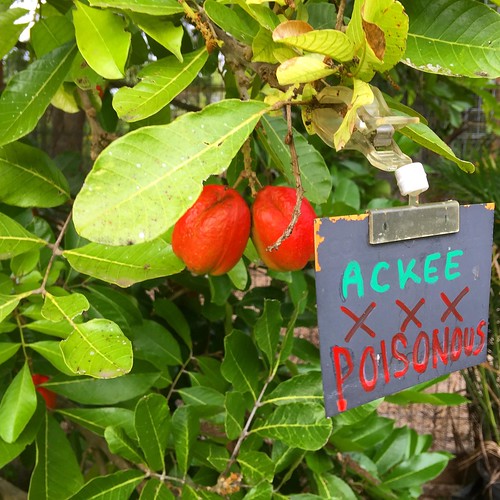
Ackee, a staple fruit in Jamaica, is only poisonous when unripe.
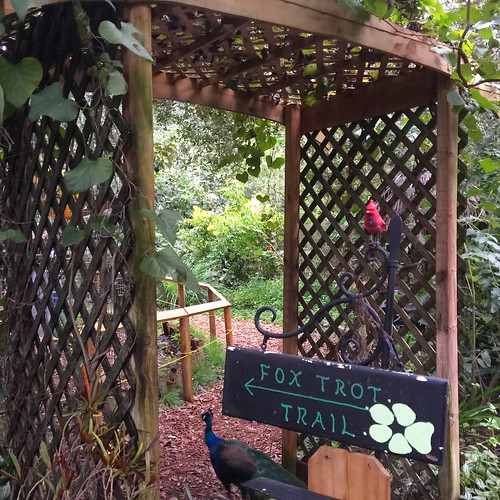
Winding trail at Safari Edventure and a resident peacock.
Grown-ups can enjoy the winding paths and serenity of the grounds, just like I did. It's a little slice of backcountry exploration with an old Florida feel, just a few minutes from US1. Picnic benches are wedged under a huge banyan tree. An enormous avocado tree, laden with fruit during my visit, shaded the Fox Trot Trail, which is home to a Mynah bird with astounding digital-sounding vocalizations. I thought R2-D2 was following me around the corner. Actually, a beautiful peacock did seem to trace my steps.
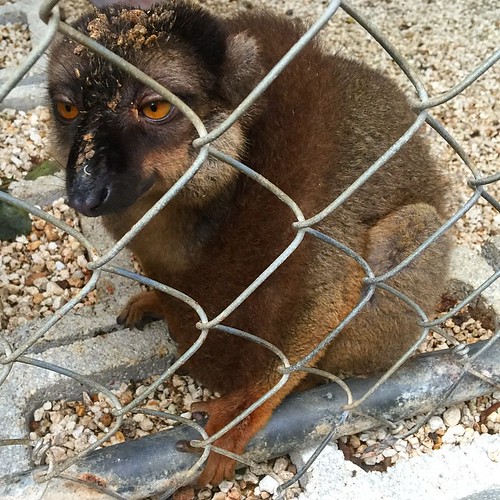
This lemur is a resident of the Fox Trot Trail.
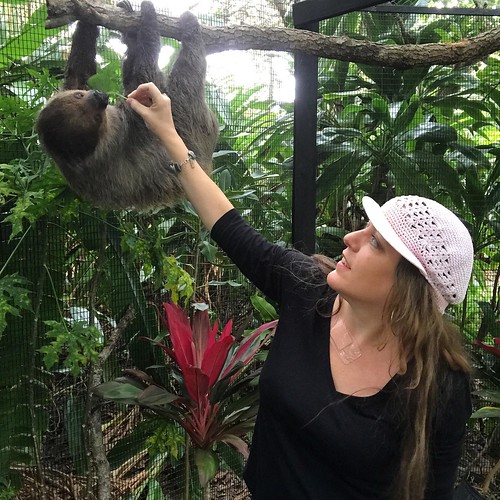
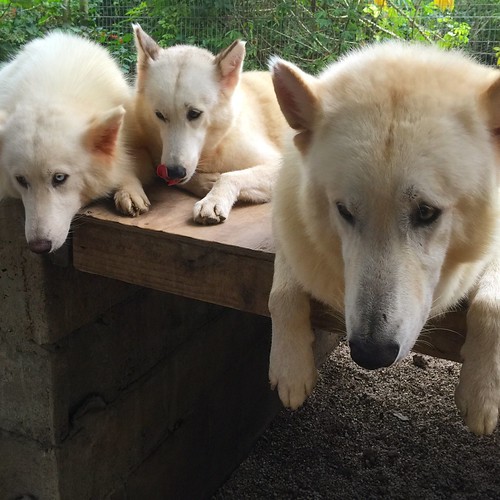
Safari Adventure also isn't your ordinary petting zoo. I touched and fed a sloth. I also petted very tame timber and arctic wolves, which reminded me of a time that I met a woman in Hawaii while she walked a wolf dog on the beach. The animal required a special permit to be on the island as her emotional support pet.
I would never think to come close to such a majestic animal, but here, these wolves were gentle and seemed to enjoy interacting with humans. There's something definitely grounding and healing about petting a wolf.
Arctic wolves at Safari Adventure.
Solace Health Miami thinks so, too. This South Florida behavioral therapy provider brings patients here for animal-assisted therapy. The nature-focused holistic treatment helps those who suffer from behavioral, emotional and other psychological disorders.
And then there's nature deficit disorder, which isn't a medical condition but a result of not spending enough time outdoors under peaceful circumstances.
For those of us who are simply stressed-out by the jarring, fast-paced energy of Miami, take a hint. A day in the Redlands, surrounded by nature, is just what the doctor ordered.
So don't come here to do anything. Just be.
Safari Edventure is at risk of losing the land, which would leave its resident critters homeless. You can support this non-profit by visiting and spreading the word.
For more information, call 305-238-9453 or visit SafariEdventure.
Mouse over the image below to see more photos from Flickr.
Here we go again. Tropical storm Beryl hit before June 1st, the official start of Hurricane Season 2012.
Oh my! Can it be already one year? How time flies! Jeremy Wade of River Monsters did a great job as Hurricane Season Boyfriend 2011 but it's time to pick a new one today. It's June 1, the official start of hurricane season and with three named storms already, we're shaking in the knees.
We've had many nominations, including Old Spice Guy. But he's a little too laid back for this role. Sure, he's suave and smells good, but he probably wouldn't stand in line for three hours just to get you an ice cube that's going to melt on the way home. He's a lady man. And only a true love would put up with such a stupid errand just so you can have a cold Skinny Girl Margarita.
Some of our Florida femmes got political. A favorite nominee was Barack Obama: "He can expedite your FEMA request like no other." Sure POTUS would be great for dealing with bureaucracy in the aftermath, but we just get an icky feeling about all those secret service agents looming about, especially if they're not servicing us.
GO WILD
Ladies, you know that each hurricane season we must have steadfast partners for six months. These men, who are utterly dispensable during the tourist season, must be able to put up hurricane shutters in 50 mile per hour winds while fierce rain falls sideways, hard rain drops pelting their shirtless, sinewy chests. They must also be able to handle wilderness in the aftermath of the storm and by wilderness, I mean your whining ass after two weeks without electricity and waxing appointments. You must be able to trust this man with a machete, if you know what I mean. He aint just cutting a swath down fallen Banyan trees in your driveway.
The best Hurricane Season Boyfriend isn't afraid of nature nor the beast within -- you know that beast within you that complains about not having a hot shower and having to eat moldy peanut butter sandwiches instead of raw vegan salads from Whole Foods.
This year, we have decided to go local and pick not one but two gentleman who would fit really the bill. Why settle for one pair of balls when you can have two? That's four cojones for the price of one!
So without further ado, drum roll please ...
HURRICANE SEASON BOYFRIENDS 2012
Paul Bedard and Jimmy Riffle of Gator Boys. Photo: Animal Planet/Bob Croslin.
What's not to love? Just look at them! They are knee-deep in the swamp because they want to be, not because they have to.
And you know, after a month or so with a tarp protecting the roof, your house is going to look like this anyway. After the storm surge, expect a wayward snapper from Biscayne Bay to land on your car. Lizards, scorpions, a boat that was moored in a marina 20 miles away, lost hipsters and drug-crazed zombies might also show up on your mud-covered Ikea sofa.
Eventually, weeds will start growing from your lingerie drawer. The simple engineering and well-ventilated design of a humble thatched-roof Seminole hut is going to make way more sense than a waterfront McMansion.
Or if you're an urbanite, you're going to curse the day you invested in a glass-and-steel Brickell condo on the 50th floor because of the "great view." Start making friends with carrier pigeons now. If an Andrew category five hits downtown Miami, you're going to need a helicopter to to deliver pizzas from Fort Lauderdale because Miami will be out of power and you won't be able to charge your mobile phone.
THE GATOR BOYS
But we digress! Why focus on the hardships of surviving a hurricane when we have luscious men to make it all better?
In addition to water and batteries, these biceps and forearms should be in every single woman's hurricane supply kit. Photo: Animal Planet.
Take a look at Paul Bedard. Would you kick this tri-athlete out of what's left of your mattress when the roofed caved in over your bedroom? I bet not. You see that groovy necklace he's wearing? That could double as a cuticle pusher, a hair accessory and a nifty utensil in case you have to gut a python if that's all daddy could bring home for dinner that night from the hunt.
Don't you love a man who can tame a beast from on top? Photo: Animal Planet.
And just feast your eyes on cutie pie Jimmy Riffle. If he can cuddle a ferocious reptile without fear, imagine what he could do with you if you had PMS!
Also, these guys know Florida. They've worked out of Weston and know that gators in your swimming pool are a hell of a lot safer than a mob of teenagers watching movies at a Kendall mall. And while they may not be able to haggle the price of a fake Louis Vuitton bag in Hialeah, they'll probably know the difference between a real contractor and a price gouger from another state.
(By the way, the alligators they rescue do not become purses or belts.)
The pair are like Florida's very own Brawny men, but instead of pushing paper towels, it's rolling papers. OK, totally kidding. Actually, they seem to be clean, which is a big plus. But bet you a drop in barometric pressure that it'd be fun to kick back and have a beer with these guys.
Congratulations to Paul Bedard and Jimmy Riffle of Gator Boys for becoming part of this most coveted Hall of Fame, which so far has included Harry Connick, Jr., Chef Robert Irvine, Father Alberto and Jeremy Wade, plus many other honorable nominees such as Anderson Cooper and Bryan Norcross.
To learn more about the team, visit Animal Planet's series, Gator Boys. They're in the business of rescuing nuisance alligators in South Florida.
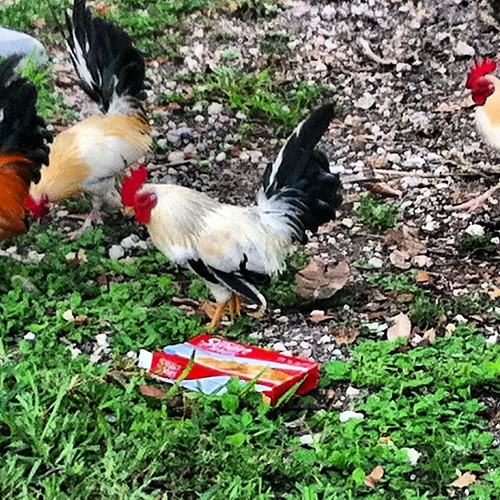
You just never know what you're going to find in Brickell. I witnessed the aggressive shenanigans of this gang of chickens yesterday while I sat at the Lucky Clover Bar during a conference call. They fought. They hung close and tight. They're the feathery terrors of Miami's hip neighborhood, lording it over the Brickell Metrorail Station, home turf to this crew of would-be poultry dishes or santería sacrifices.
Don't mess with the Brickell Chickens. And they're too sexy to pay rent or invest in Miami condo short sales, by the way.
Part 2 of a series on angling and conservation in Florida focused on the Goliath Grouper. Inspired by Jeremy Wade’s by-catch at Fort Pierce Inlet, which was broadcast on River Monsters, the series looks at many different ways of interpreting this fish and its relationship to human interests. Click here for all posts labeled “gus the grouper.”
Photo courtesy of mrscuba.com via Creative Commons. This isn't Gus, by the way.
This is what I’ve recently caught at the end of my hook: a story about a famous extreme angler named Jeremy Wade and a 350 pound Goliath grouper from Fort Pierce named Gus.
It all started out when someone from the Florida diving community pointed out that Jeremy Wade's catch of Gus was illegal on the River MonstersFacebook page. I had posted a photo of Jeremy Wade and Gus not once, but twice, prior and after the season four premiere, unaware of the regulation.
Ignorance is indeed bliss, because once I read the regulation, I felt like a hypocrite. How would anyone ever take my fishing stories seriously if I turned a blind eye to conservation? Especially as a female in a sport dominated by men who both cast lines and pen lines about fishing?
This series is my retraction.
It’s also much more than that.
Ten interviews and many more pages of notes later, I’ve come to the conclusion that everyone I spoke to was in one way or another passionate about Gus.
And I got sucked into it.
Gus has been on my mind. He has almost become an obsession. Knowing what I know now, how does the journalist in me remain impartial with cold, empirical facts when Gus himself is no longer a mere fish but the object of human passions for the sea and its creatures?
And how does the storyteller in me resist the temptation to weave a good yarn?
This isn’t just a story about fishing. It’s a story about passion.
This is a story about passion conflicted with science, business and politics, all seemingly impossible to untangle like a bird’s nest on a miscast reel.
Honestly, I can tell this story in three sentences: “Goliath grouper are protected. According to official sources, Jeremy Wade violated a Florida Fish and Wildlife Commission regulation about possessing the fish above water. Angler gets slap on wrist for broadcasting.”
That’s your Cliff Notes. End of story.
But this is also a narrative about storytelling. About me trying to figure out how to even tell this convoluted story. Because it's bigger than River Monsters or Jeremy Wade. It's about Gus and the people who interact with him in Florida: recreational anglers, commercial fisherman and divers. It's about a consciousness -- or lack thereof -- particular to Florida regarding our natural resources.
Anyone who has watched enough River Monsters episodes knows that it’s never really about the fish. Compelling fish stories aren’t mundane; no one ever regales you with facts about gear, hooks and leaders. Those stories are clinical. If that's what you want, browse the pages of a technical manual.
It’s the human interpretation of the fish and its relationship to culture that matters. It's the experience of the angler, his or her contact with the animal that moves us, brings us closer to something primal within. It's these stories that capture our imaginations and redefine our relationships to the natural world.
We don’t exist in a vacuum, separated from denizens of watery realms. What we don’t know fascinates us and what we do come to know, beckons our innate curiosity. These fish, suddenly, so remote and alien, become part of our world, our casual dinner conversation.
Well, that was just a lot of hot air from me about the mystery of fishing for sport.
To be frank, every single time I hook a fish and release it I ask myself the same question: why the hell am I doing this if I'm not going to eat it? What's the point? This is the moral dilemma of every angler who doesn't fish for subsistence. The very conservation community, the divers whose point of view I respect, are in conflict with my own compulsion. At the end of the day, the best conservation is to never touch a fish at all, but we are humans, some of us eat fish and to not fish would be impractical.
In many ways, the series River Monsters has mastered the art of fish tales for mass audiences, bringing finny creatures to the fore without espousing their destruction. But many would disagree. Some say Jeremy Wade demonized Gus, when the fish is really just a gentle giant. And then there are those who wish to ban the laws that protect Gus, even though his kind was nearly fished to extinction just a few decades ago.
And somewhere in this murky water there is a truth that gives the fish a fighting chance while we humans co-exist with our environment.
"Gus the Grouper" isn’t just some fanciful idea I concocted to feel less guilty about my own lack of knowledge about a particular regulation. It isn’t just about what Jeremy Wade did in Florida last summer. There’s also a great opportunity here for education, to get to know Gus and his kind, to be more mindful as anglers.
Armed with as much knowledge as I can possibly acquire before going down into a deeper research wormhole, I’m going to tell this story the way I know best, from my heart, without losing sight of the facts.
Part 1 of a series on angling and conservation in Florida focused on the Goliath Grouper. Inspired by Jeremy Wade’s by-catch at Fort Pierce Inlet, which was broadcast on River Monsters, the series looks at many different ways of interpreting this fish and its relationship to human interests. Click here for all posts labeled “gus the grouper.”
My name is Gus. I’m a very big fish but I wasn’t always so big! When my parents met, they had traveled far from their homes to make babies on a reef. And once they made me, I was just a tiny little blob. I floated alone on the currents of the ocean to an estuary, a very special nursery close to land.
I spent the next eight years of my life growing up in the underwater roots of mangrove trees. Other baby fishes also called this protected place home, but it wasn’t easy being so small a baby fish. I had to fend for myself. Bigger fish, birds with big beaks and alligators weren’t my friends.
Baby fish grow up in the Florida mangroves. Photo courtesy of Cletch's Flickr.
By the time I was eight years old, I was already pretty hefty and tough. I had outgrown the mangroves and felt like exploring the big, wide world. I set out toward the ocean, determined to find a nice new place to live.
I ended up settling in an inlet, a place where a river meets an ocean. My home was grand, a shady spot under a big castle made from sand by crafty worms. It wasn’t a bad place to live for a young grouper like me!
I’ll admit my life wasn’t particularly exciting. I kept to myself, venturing out from my home every now and then to see what was going on in my neighborhood. I ate smaller fishes, crabs, lobsters and yucky things that live under the sand.
But life wasn’t always boring. I kept getting bigger and more curious about the things in the world around me. Sometimes, these weird creatures that didn’t always live here and didn’t look like fish and flashed lights at me would pay a visit to my castle. They’d blow bubbles that would rise to the strange, airy world up above.
They never bothered me, though. And sometimes, I’d let them tickle my belly if they were kind and gentle.
But sometimes, the very same weird creatures that blew bubbles would take my neighbors away after piercing their bodies with a stick.
One day, I felt an urge to go somewhere. I wasn’t sure where I was going, but I knew I just had to go and leave my comfy home for a while. I swam out to the ocean until I found many other groupers just like me!
It was here I spotted the prettiest grouper lady fish I had ever seen.
I tried to get her attention. I danced around her, even changing my colors and yelling a loud BOOM with all my might! Boy, did I really want her to notice me instead of all the other handsome groupers!
We never really touched, but next thing I knew, we had all made grouper babies. And just like me many years ago, a new little blob floated on the currents to an estuary where it would grow up in the safe, watery world of the mangrove roots, learning how to fend for itself.
My romance didn’t last long and I swam back home to my peaceful life.
But once a year, I returned to a reef where I courted another lovely grouper lady fish and made more grouper babies.
I am now a big, strong grown-up fish and I have many birthdays to look forward to. I just hang out under my shady spot, occasionally taking a swim around the neighborhood. And once a year, I go meet a lady fish grouper.
Those weird creatures that blow bubbles and aren’t fish and flash lights at me come visit my spot from time to time.
Sometimes, those very same weird creatures cast a shadow on the waters above me. I hear a funny noise, a rrrrr followed by a clank-clank. I’m not sure what happens up above in that airy world, but I do know that whenever that shadow, rrrrr and clank-clank happen, some fish make a mad dash to the surface. If I’m hungry, I’ll hang out under that shadow. I’m not a dumb fish. It’s a free lunch.
But even though I’m big and powerful, I never eat more than I need to survive. Us groupers watch our figures, you know.
One day, not long ago, I was just roaming around my neighborhood when I spied a very juicy piece of fish.
And then something extraordinary happened.
No sooner did I chomp on the tasty morsel, I felt an incredible pull in the opposite direction I wanted to swim. I wasn’t quite sure what was going on! It was very strange. The harder I tried to get away, the more difficult it became to let go. Whatever it was, it was dragging me close to the beach. I like the beach, but I’d rather always be underwater.
Next thing I know, one of those weird creatures that aren’t fish was looking at me but this time, it wasn’t blowing bubbles. There was something stuck in my mouth, which it took out right away. There were more of those flashing lights and then just like that, it let me go.
My lip hurt a little as I swam back home, a bit tired and confused. First of all, I didn’t get to eat the fish, so I went to bed without dinner. And then I didn’t understand why it let me go after all that pulling and pushing between us, but I’m glad it did.
That was surely a strange day.
So I am still here calling the inlet my home, hoping to grow into a very old grouper with more stories to tell.
If you see me, say hello and if you catch me, let me go.
NOTES
The above creative interpretation on the life of a Goliath was crafted from research based on personal phone interviews with several legitimate sources; however, I claim no absolute scientific accuracy.
The fish is called Gus because a source who dives in the Fort Pierce area claims to have recognized the fish caught on River Monsters and had already named it thusly. Stay tuned for more …
Part two of a two-part series behind-the-scenes on the set of Ford Escape Routes. Click here for Part One.
Day two of my behind-the-scenes shenanigans with Ford's reality tv show Escape Routes was even better than the first, since we schlepped out to the Sawgrass Recreation Park just outside the gates to Alligator Alley in Weston. And you know I love me some Glades; I wear a silver crocodile ring, for pete's sake.
For Everglades newbies, this is an ideal area to explore the River of Grass without getting too hardcore deep into the mucky wilderness. You can see the Panthers Stadium in the distance, so you know you're at the border of civilization.
THE COMPETITION
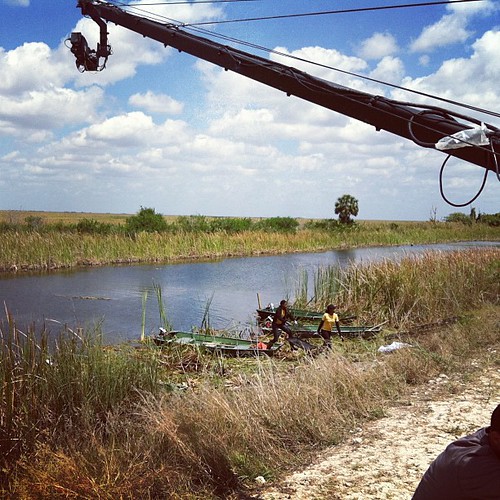
Each team of Escape Routes had to row and troll an aluminum skiff across a man-made canal, retrieve "show" alligators and snakes from the handlers, put them in pens or bags, return to the other bank and place the "captured" critters behind competitor's cars.
The animal handler I interviewed said that the alligators who were part of the competition were raised in captivity and used to this kind of thing. But the human cast? Most certainly not!
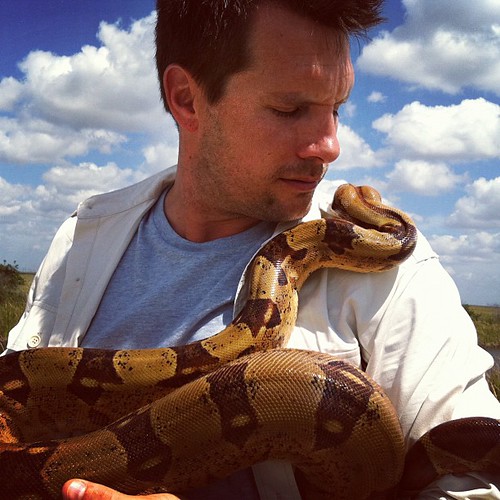
Host Rossi Morreale looks very comfortable with his slithery friend and that's because he once owned a Colombian boa -- and no, not the kind a drag queen would wear.
It was a hoot to watch them get waist-deep into the water in their camouflage snake boots, rowing like mad and some not quite sure how to use the trolling motor. Folks, it's like using an immersion blender when you purée hot soup: stick it in the water if you don't want it to splash and sputter!
THE PRODUCTION
The whole competition took about an hour, but we waited quite a few more before it happened. So I had time to poke around when I wasn't annoying the field production manager with questions about how close I could get without appearing in frame. (He was a very nice guy, by the way.)
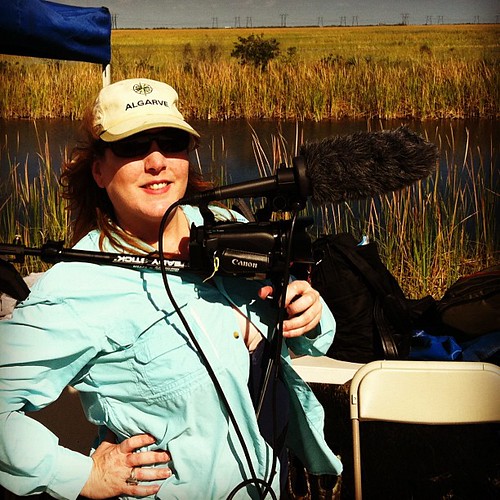
The scene before shooting. I was filming behind the jib, hoping it wouldn't knock me on the head when it swiveled.
Yours truly with her humble gear. That steady stick is a lifesaver. I'd have no arms or shoulders left by the end of the day if it weren't for that gadget.
Prior to this week, I'd never been behind-the-scenes on a reality TV show set. The competition was interesting, to be sure, but seeing all the production technology set up in the Glades, almost in the middle of nowhere, was quite impressive.
The director's tent was hooked up to massive servers, cameras were rigged wirelessly to a huge monitor, standing microphone receptors were placed along the levee -- all powered by one single portable generator.
Unlike many other reality tv shows, this one is filmed Monday through Thursday with an air time of Saturday evening. I bet the director and editors never sleep. As well, because of the show's in-depth social media engagement, there's much online content to process. It's an intense six weeks not only for the cast, but for the crews and creative teams that make it happen.
But back to the competition! Terence was one of the first to be eliminated and it was fun to hear him from the peanut gallery as the others raced to finish. Each team worked well together, huffing and puffing to get the job done. The lovely ladies of Team Yellow won -- not bad for two models who had never stuck a foot in gator-infested waters!
ABOUT SNAKES AND GATORS
By the way, it was a bit ironic that snakes and gators would be featured on the same show. You know, we have a little problem here in South Florida with invasive pythons, just ask the USGS. And remember this photo of a python bursting out of a gator's belly?
But I can assure you, all the animals on the set were captive and treated royally. If you do go out into the Everglades, make sure you know the difference between your native and non-native reptiles. Learn more at the Florida Fish and Wildlife Commission website.
And don't forget to follow the gang on Escape Routes, airing for another two weeks on NBC at 8PM.
More photos on Flickr:
FTC BLA BLA BLA
Yes, I was paid to write this, get over it. All opinions mine and I drive GM car.
Ten reasons why a behemoth dry dock boat storage facility should not be developed in Matheson Hammock Park.
More reasons here. Please sign the petition to save Miami-Dade's most pristine urban sanctuary from greedy exploitation. Email Coral Gables commissioners, too.
If you thought getting into a South Beach club was difficult, try being a Burmese python with Ron Rozar around to check you at the door. It just aint gonna happen.
One of my favorite places to stop on my way down to the Keys is Alabama Jack's on Card Sound Road, where conch chowder, fritters and beer can be savored among the mangroves. Card Sound is at a fork in the road to the Florida Keys -- veer east from the Last Chance Saloon and you skip the U.S. 1 18-mile stretch between Florida City and Key Largo to drive through a crocodile refuge.
The American crocodile is welcome here, but another reptile is not -- the Burmese python. Since 2007, 14 specimens of this invasive species have been found in Key Largo alone.
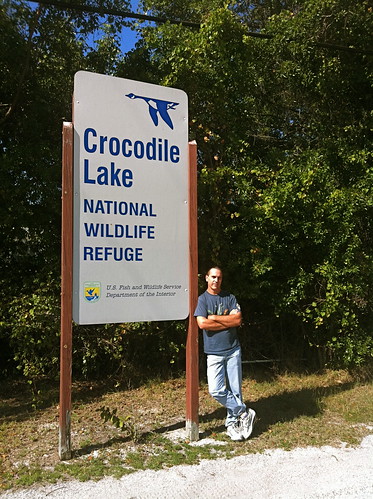
On a recent trip to Key West, I went off the beaten path once again, this time stopping to chat with Ron Rozar, biologist and herpetologist for the United States Geological Survey (USGS), which has set up office at the Crocodile Lake National Wildlife Refuge. The refuge is part of the United States Fish and Wildlife Service and protects one of the largest remaining tracts of hardwood hammock, a globally threatened habitat.
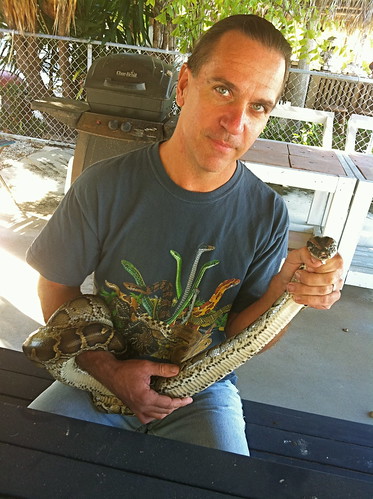
Rozar works on the Python Project, setting traps, doing research, training law enforcement responders and educating the public about non-native species.
If you're a Burmese python, you don't want to mess with Rozar. Ruggedly handsome yet soft spoken, he's a sophisticated Crocodile Dundee of our South Florida backyard, helping restore the Keys ecosystem to its natural state.
SNAKES R US
According to Rozar, the USGS is one of a few organizations in the world with snake management experience, with a case study in Guam that serves as a cautionary tale for Florida.
Sometime after World War II, the brown tree snake from Papua New Guinea made its way to the island where there were no indigenous snakes. It didn't take long for the invader to decimate native species. The USGS intervened in the late 80s.
"By then, all the birds had disappeared," said Rozar. "It ate every bird species, one-half of all lizard species and three bat species on Guam."
A similar invasion would be devastating to South Florida's environment.
Sorry tourists and locals, but the refuge is off limits and that's a good thing for the animals. There is, however, a lovely tiny butterfly garden on the premises that you can roam and humans are always welcome at Alabama Jack's, about 20 minutes away across the Monroe county line.
The first Burmese python on record in South Florida was discovered in 1979 in Everglades National Park, but the population didn't shoot up until the late 90s. "Founding populations are low," explained Rozar. "Then they hit a threshold point when males and females find one another and start breeding."
One infamous Everglades python made the news in 2005 with a shocking photograph of a gator piercing through its gut. (See the photo at National Geographic.)
With the 2007 appearance of a Burmese python in Key Largo, USGS sent Rozar down from Miami in 2008 to deal with the problem.
That 2007 python wasn't found randomly. Researchers conducting a telemetry study on endangered, native wood rats found two of the tagged furry critters dead inside a python's belly. There are only about 200 Key Largo wood rats in the world, indigenous to the north section alone -- a very small and specific biological niche.
This cute little critter might not stand a chance against pythons. Woodrats are not the only threatened species in the Keys -- the cotton mouse, marsh rabbit, key deer, to name a few -- are in peril for a variety of reasons. Photo by Clay DeGayner volunteer for U.S. Fish and Wildlife Service via FAVOR.
In the hierarchy of nature, alligators and crocodiles reign supreme in the Glades and the north Keys as apex predators. But the Burmese python is another master at ambush, lying in wait in the water with only nostrils and eyes visible, waiting for a meal to walk by -- a bird, another reptile or maybe even a bobcat or deer. A constrictor, the python is smart too, aiming to tighten the lungs of its victim, waiting for the heartbeat to stop before swallowing it whole.
And swallow they can. "A deer was found in the stomach of a python in Everglades National Park about a month ago," said Rozar.
Even more troubling was the discovery of a seven-foot Burmese in Marathon. That's too close for comfort to Big Pine Key, which endangered key deer and other species call home in the National Key Deer Refuge.
Burmese pythons can also travel.
"All snakes swim," Rozar explained. "They might not be happy in saltwater, but they can navigate from Florida City, where there is an established population, to Key Largo. And before U.S. 1 was fenced in, we found python road kill. Snakes are attracted to the heat of the asphalt."
"Part of the problem is that we don't always know where the snake came from," said Rozar. "Some may be from the Florida City population, but others may be escaped or released pets. The climate is favorable for them here and they can thrive out in the wild."
BE A RESPONSIBLE PET OWNER
"Port of Miami and Port Everglades are hubs for exotic animal imports, making it easier to buy these animals here," said Rozar. "The exotic pet trade has an incredibly powerful political lobby."
An illegal trade could bolster a black market, but the Florida Wildlife Commission doesn't want the average Joe to buy pythons anymore. On July 1, 2010, the Burmese python was listed as a conditional species and could no longer be purchased as a pet. Only properly licensed dealers, public exhibitors and researchers can possess a Burmese python.
Pet owners with pythons prior to that date were grandfathered in but must maintain a valid license. The commission doesn't turn a blind eye. Earlier this year, a West Palm Beach man was charged with illegal possession after his snake wound up in a parking lot near a multi-family home.
But still, other reptiles abound in pet stores and are available from breeders. The Argentine tegu, for example, is a non-native lizard and aggressive egg predator.
"It may be tempting to buy a reptile when it's small," cautioned Rozar. "But educate yourself. These animals require very specific care."
WHAT YOU CAN DO - RESOURCES
"Everyone is a Florida Wildlife Commissioner" -- wise words I recently heard at the Ladies, Let's Go Fishing seminar. Rozar agrees.
Report an exotic. If you're in the Keys, call 1-888-IVEGOTONE and a trained, rapid responder will be dispatched to your location. Report the finding even if it's not current -- all collected data helps researchers.
Have an unmanageable exotic? Don't release it into the wild. That's illegal. Give it up for adoption on Pet Amnesty Day organized by the Florida Fish and Wildlife Conservation Commission.
Watch Operation Wild. The show follows Florida Wildlife Commission officers as they rescue animals and enforce laws. It's currently airing on local cable at Animal Planet.
Also watch Swamp Wars on Animal Planet, which follows Miami-Dade Fire Rescue's Venom One unit as they respond to snake bite reports and sightings of dangerous invaders.
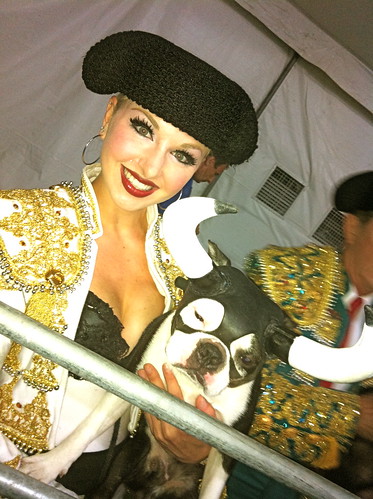
I'm not really a dog person, but I did have a chance to see the Incredible Dogs show, which is still playing under a tent at Bicentennial Park until October 23rd. It's actually quite fun to see these dogs -- most of them rescued from shelters -- perform some amazing tricks.
This lady was one of the more elaborately dressed of the performers. You get to meet and greet the dogs and their trainers at the end, which is a special treat.
A Maria Miami tip: if you go, save a little money by parking in the meters on the side streets across Biscayne Boulevard. Miss Yip is a nice place to go for Chinese food and cocktails before or after the show.
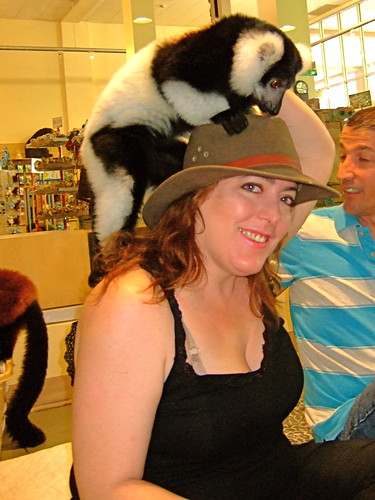
Lemurs jumping on me! See why I write about stuff that's more interesting than sex?
Life is all about serendipity. After I saw the amazing Animal Planet documentary Madagascar, I found out through a friend that Jungle Island here in Miami has an interactive lemur experience. This was on my bucket list and I didn't even know it was in my own backyard.
The lemur experience is the most fun you can have with your clothes on! Seriously. Mind you, I interviewed Ron Jeremy a few weeks ago but these primates were more touchable and less hairy. (Sorry, Ron, you're still awesome in your own way.)
For the lemur experience, a small group of people enters a nursery where juvenile lemurs are taken care of and, I might add, spoiled rotten by a lovely care giver. You sit on the floor and the pro-simians -- they're primates but not technically monkeys -- are let out of their enormous cage for playtime. They jump and leap all over the place, including you; you're part of the props. They eat treats out of your hand and just generally frolic.
As a yogi, I found it very grounding and therapeutic to hang out with the lemurs. I got in touch with some primal part of myself that had nothing to do with my damn iPhone, Facebook or Twitter. A truly "social" event, with no words spoken and none of the encumbrances of being human. One of them even nibbled my finger without biting!
I will probably go back to do this again from time to time because it's not like you can handle lemurs just anywhere in the world. These primates are endangered and heck, that plane ticket to Madagascar costs quite a few clams. This was truly a very special experience.
While most people come to Miami for beaches and nightlife, no one ever thinks to touch a Madagascar lemur right here on the shores of Biscayne Bay.
Lemurs are fascinating to me because their sexual and social behavior is worth pondering. In the animated movie Madagascar -- wildly riotous and funny for kids of all ages -- there is a lemur character named King Julian. But here's the thing: lemurs run a matriarchal society, so there is no "king" to speak of, only a queen. Women rule! So I guess that's a right match for South Beach, right? It's full of queens.
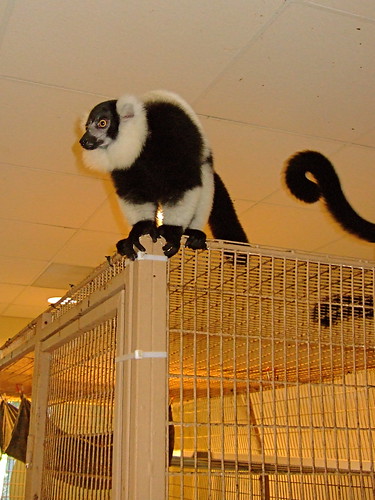
I'm not sure if this was "Nibbler" or "Athena" ... in this particular group, there were four females and one male.
Female lemurs are only available to mate for a very short period of time -- we're talking 24-48 hours -- once a year. So the guys better be on the ball and get their mating on or no future lemur babies will happen. This is all timed to perfection, so that lemurs are born just around or after the monsoon season when there is plenty of food.
Lemurs are not particularly monogamous. It's a fair game mating sperm war, so oh boy, those 24-48 hours of mating must be quite a spectacle of sex.
Credit: Animal Planet/BBC
Lemurs are also interesting because of the way they move. Think of a slow motion elegant ninja combined with a capoeira dancer with perfect posture. The yogi in me very much admires the flexibility and jumping power of these creatures. I think I need to create a lemur pose.
The Jungle Island lemurs are bred in captivity at refuge in Tampa; in my recent encounter with them, this particular troupe was just a few months old.
Eventually, the lemurs return to that facility where they spend the rest of their lives in as close as possible an environment to native Madagascar. The Tampa spot is not a public attraction, but rather a conservation sanctuary.
I had a bit of a moral dilemma with this as there is always the big question of how sad it is to see animals in captivity. But let's face it, we humans are stewards of the planet and we do "capture" animals, in every sense of the word, as they do us.
The old Parrot Jungle (the attraction preceding Jungle Island in Pinecrest) is a place I went to as a child and where I first learned to appreciate the animal kingdom. I think experiences like this further cement and bolster our potential to preserve and respect nature. I felt like a kid again coming here and breathed a sigh of relief knowing that there was something so special in a destination otherwise known for shallow entertainment.
I interviewed Mel, one of the animal handlers, after our group experience. The camera is a bit shaky, but that's because the lemurs were jumping all over the staff member who was kind enough to hold my phone! A very challenging shoot, for sure.
IF YOU GO
The 45-minute lemur experience is limited to adults or children of about 10 years or older who are well behaved. If you are skittish about animals and are a Monk-like OCD germaphobe, this is not for you -- although everything is extremely clean and tidy. But hey, if you have dogs and cats, you really shouldn't feel weird about this. There is a liability form to sign, but honestly, it's probably more dangerous to drive to Jungle Island than to spend time in close proximity to these animals. The lemurs are very soft and furry; they'll jump on your head and extend their tender paws gently when offered a raisin or bit of cereal.
At time of publication, the lemur experience costs $45 exclusive of entry to the rest of the attraction, which is a whole other park and a great place to visit if you only have a short period of time to explore South Florida. There is a beautiful tropical garden path (you won't see that many trees in South Beach) and even an authentic Everglades boardwalk, with mangroves, egrets and alligator gar in the ponds. For more information about the park, its shows and events, visit Jungle Island.
No, this isn't a private beach at a luxury resort in the tropics, it's a beach in the evolutionary marvel of Madagascar, an island off the coast of Africa. Strange creatures that don't live anywhere else in the world call this beautiful island home, where extremes are the norm. Dry seasons, tropical monsoons, rugged terrains, lush forests and the challenges of survival make for some weird mating habits -- all far more interesting than human sex, for sure!
Pygmy chameleons. Credit: Animal Planet/BBC
Talk about having a hard time finding a date. Not even eHarmony would work for the determined male pygmy chameleon, who searches for his tiny counterpart on the thick, leaf-covered forest floor. She is barely two inches long and he is even smaller. Once he finds her, he climbs onto her back and latches on tight, staying there for days before mating. God forbid he should lose her ... or maybe he just wants a free ride.
Yellow frogs mating at Kirindy. Credit: Animal Planet/BBC
This variety of frog is brown year-round except for the short-lived rainy season when they go into a spawning frenzy. The males turn yellow, although no one knows why. Maybe they want to avoid copulating with the same sex. When the waters rise, the frogs hump each other, all pairs side by side, putting any swingers club to shame. Once they lay their eggs, it's back to drab brown for the guys.
But most fascinating is the sexual behavior of the polyandrous Vasa parrot. That's just a fancy word that means the female is a little slutty and sleeps around. But she does this to ensure the survival of her brood, fooling each mate into thinking he's the baby daddy. Perched high atop a tree, she calls out her "come hither" cry and more than one guy shows up to feed her. A girl has to do what she has to do, right? She gets more food for her babies with minimal effort. Pretty damn clever.
The 2-hour Animal Planet special, Madagascar, premiered in March but has been airing on my local cable recently. Stunning visuals and beautiful narration make this a must-see. Catch it if you can. It airs again on October 1st.
Visit Animal Planet to learn more about conservation efforts in Madagascar.
A recent trip to Butterfly World in Coconut Creek had us dusting off the kama sutra. Is this doggie style or a freaky reverse cowgirl (note the position of the legs). Oh yeah, and in grasshopper world, it's totally ok to watch.